The Unicorn, from mythical fantasy to emoji 🦄
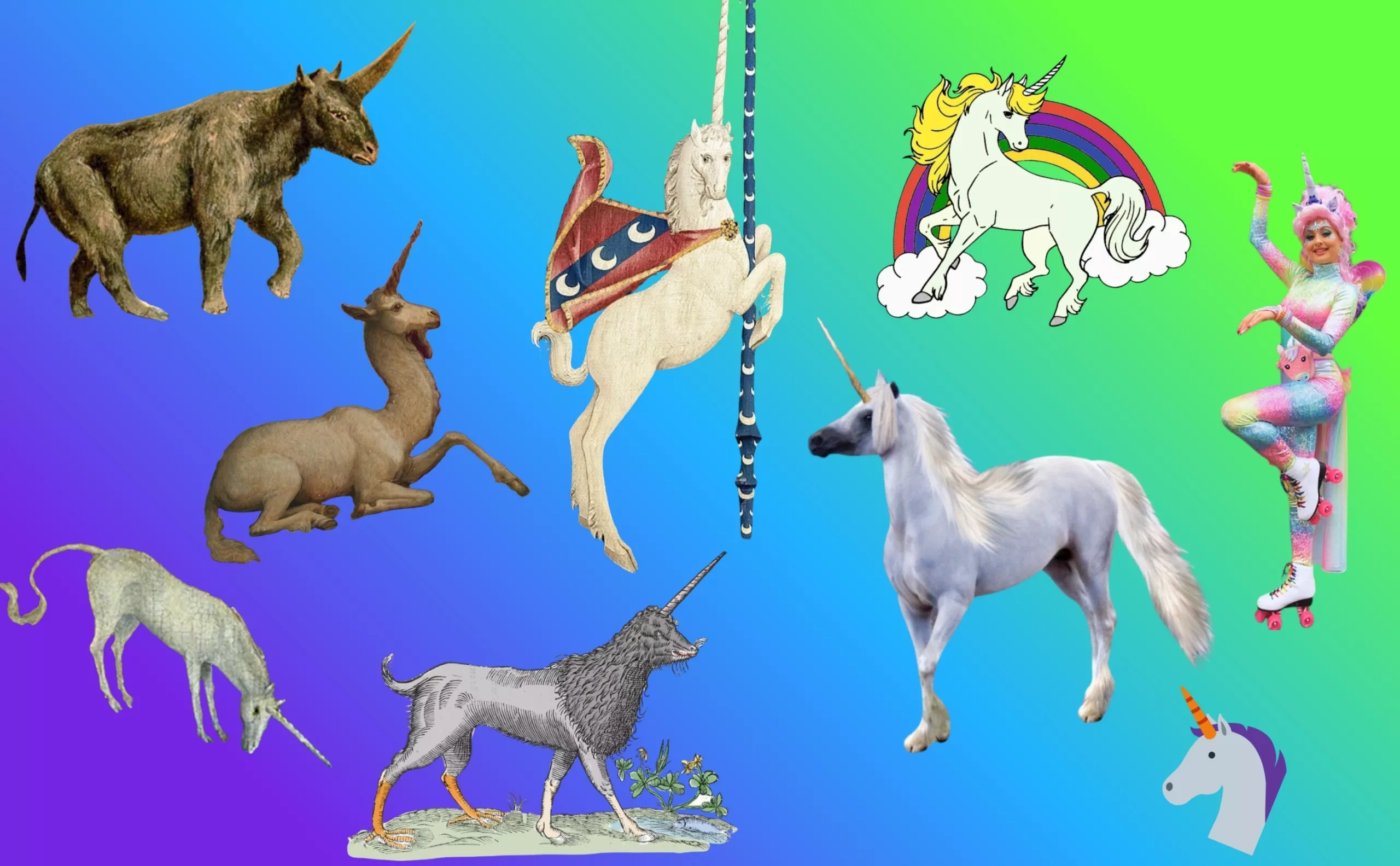
A rainbow-maned, rainbow-droppings-spewing LGBTQIA+ pop icon, the iconic unicorn has lived through centuries and cultures, changing in appearance and symbolism along the way. Once a chimera with the body of a deer or the mane of a lion, this wild beast became an allegory of Christ in the Middle Ages, then a heraldic symbol, and also a source of miraculous remedies. Today, it appears on girly, glittery accessories: how did the unicorn make such a giant leap, from myth to emoji?
The various forms of the unicorn
The Musée de Cluny, which is dedicating a remarkable exhibition to the unicorn until 12 July 2026, invites us to follow in the unicorn’s footsteps across Egypt, Tibet, Mount Sinai, Africa, Siberia, the forests of Europe, the Americas and China. Wherever it treads, the creature is endowed with extraordinary powers.
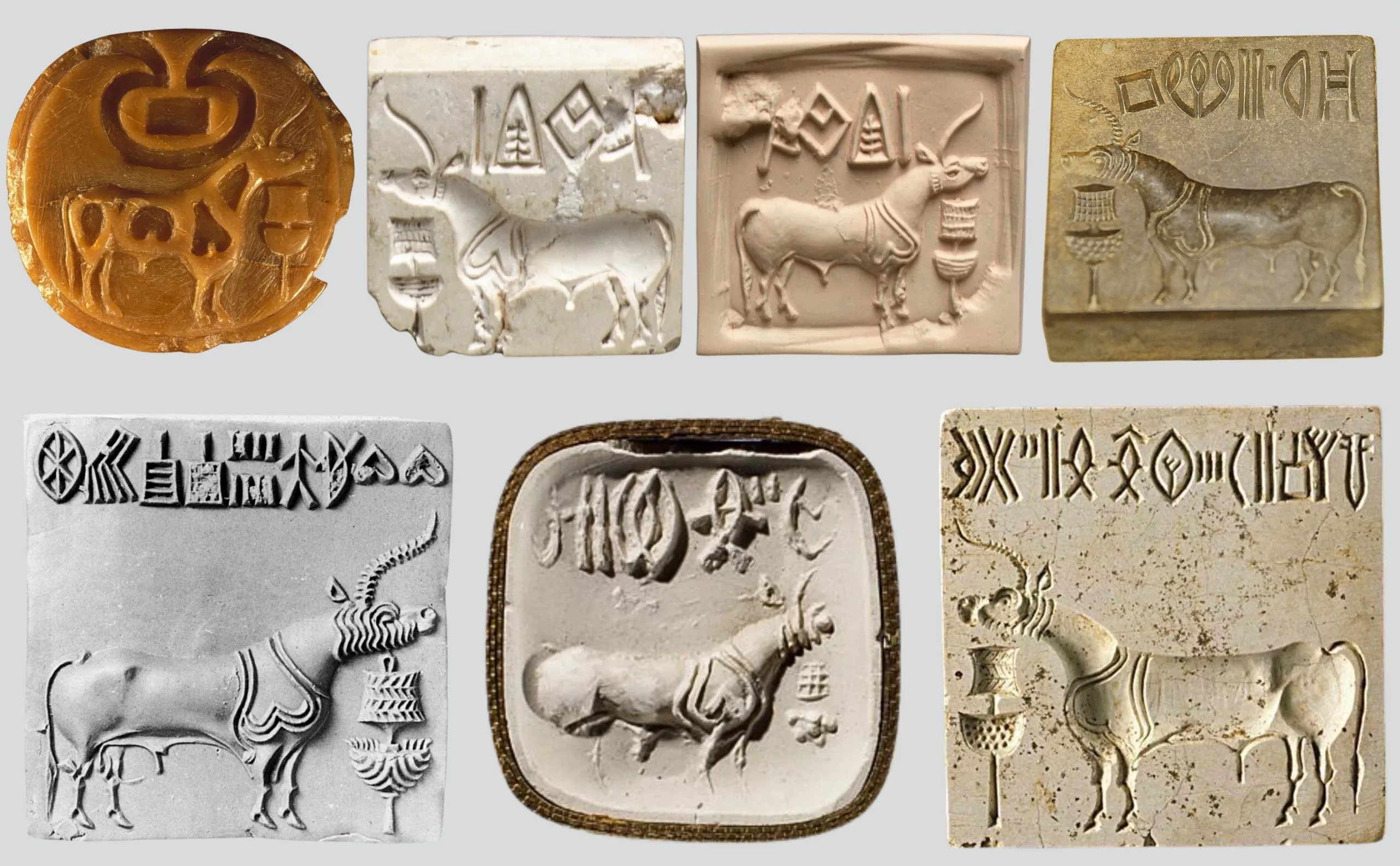
It is in India, within the Indus civilisation around 2600 BCE, that we find the earliest representations of unicorns. They may be one of the avatars of Vishnu, drawn from the tale of Ekashringa (from Sanskrit: eka (एक) = one, unique + shringa (शृङ्ग) = horn).
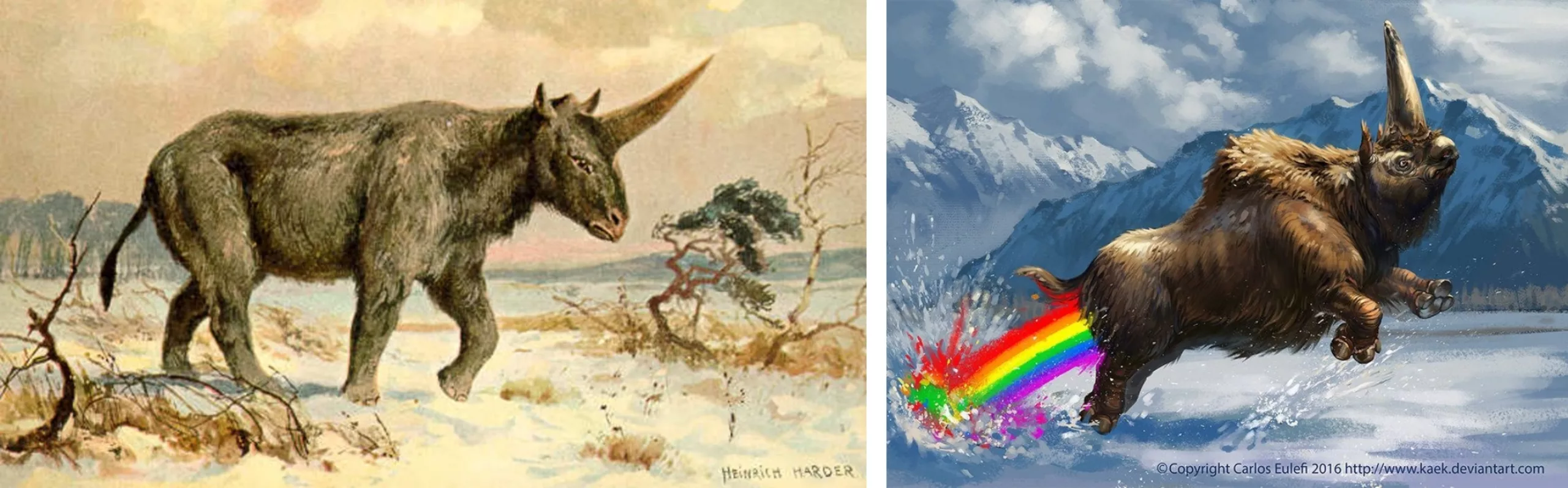
Or perhaps it was a descendant of the Elasmotherium sibiricum, a giant single-horned rhinoceros that coexisted with humans in Siberia until around 39,000 BCE?
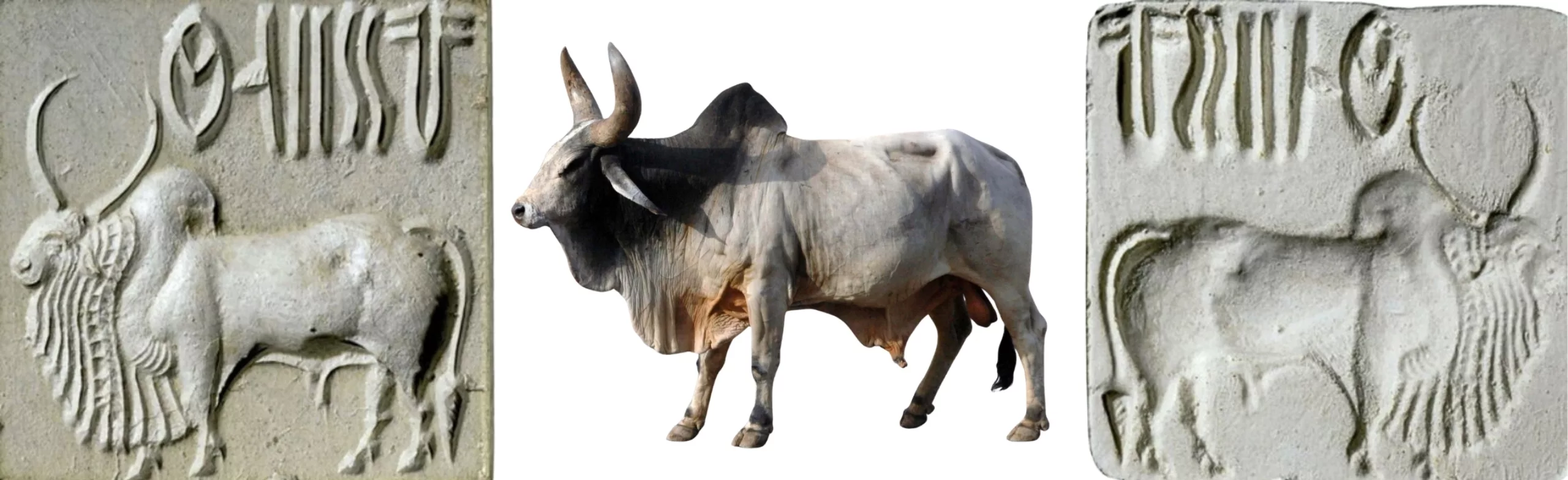
The trail of the simple cow can indeed be ruled out, since other seals depict them in profile, clearly showing two horns. The mystery therefore remains…
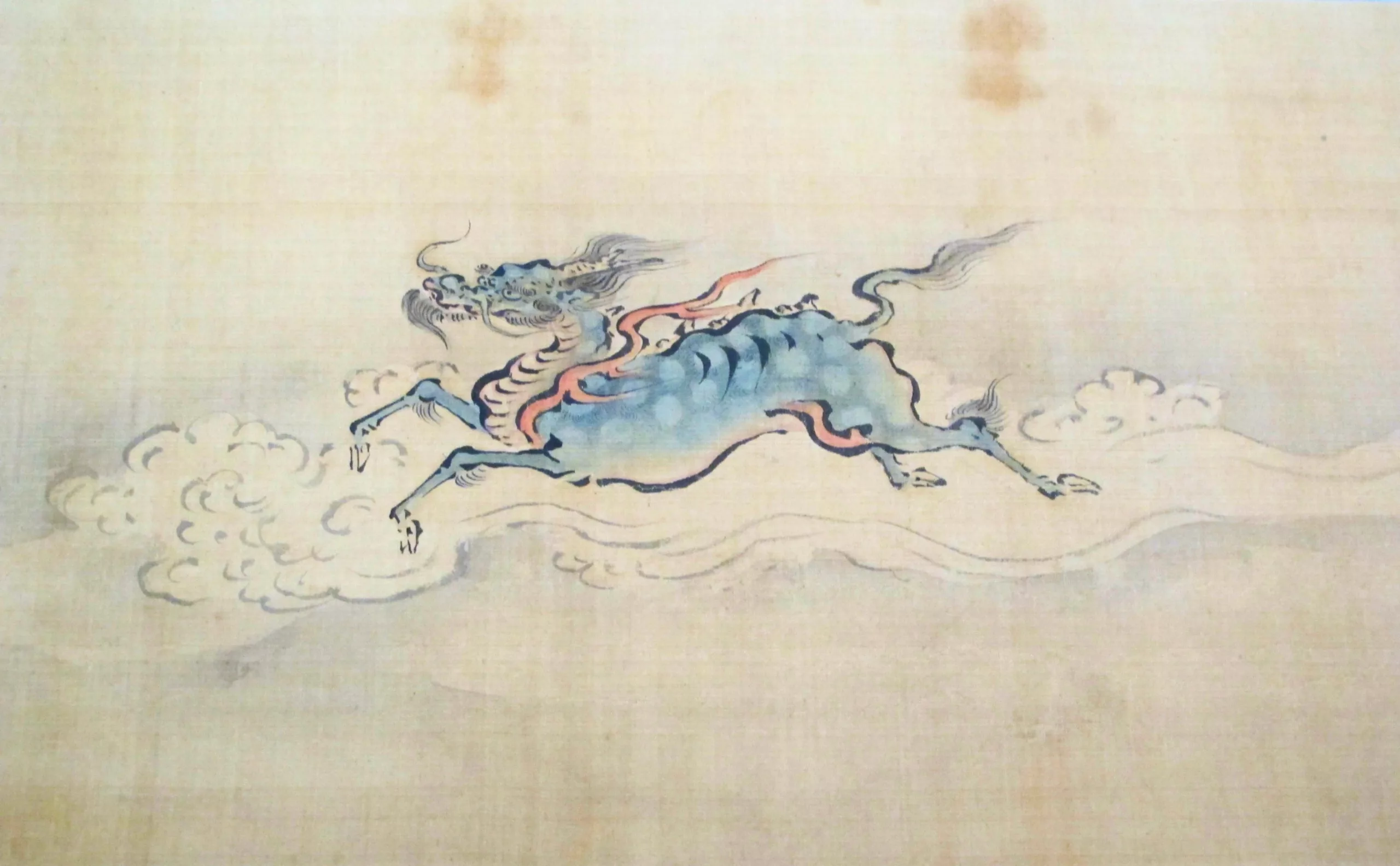
Some 4,600 years ago, other types of unicorns appear in China. Known as the Qilin, this chimera has the body of a deer, the tail of an ox, the hooves of a horse, sometimes fish scales and a dragon’s head, but could bear two or even three horns and whiskers. It is a “benevolent beast”, the noblest of all creatures, which damages nothing in its path, not even the grass, and can live for a thousand years. Impressive.
Later in Greece, around 400 BCE, the physician Ctesias describes the Indian monoceros, a wild white ass with a lion’s mane and rhinoceros skin, a purple head and blue eyes. Its single horn is tricoloured: white at the base, black in the middle and red at the tip. It is then the unfortunate narwhal whose horn would be used, repurposed and claimed for the unicorn, before the deception was exposed in the 16th century.
To bring some clarity, and because the 14th century loved to categorise everything (the better to understand the world), On the Properties of Things distinguishes three kinds of unicorns:
“One has the body of a horse and the head of a stag, the feet of an elephant, the tail of a boar and a horn on its forehead some two cubits long. It cannot be taken alive. It is called the monoceron. The second is called the egliceron, meaning horned goat. It is a small animal resembling a roebuck, with a very sharp horn on its forehead. The last species resembles an ox. It is spotted with white, has hard hooves like those of a horse and bears a horn on its forehead. Pliny states that in India there are asses with a horn on their forehead, but they are not as strong nor as proud as unicorns, as Aristotle and Avicenna attest.”
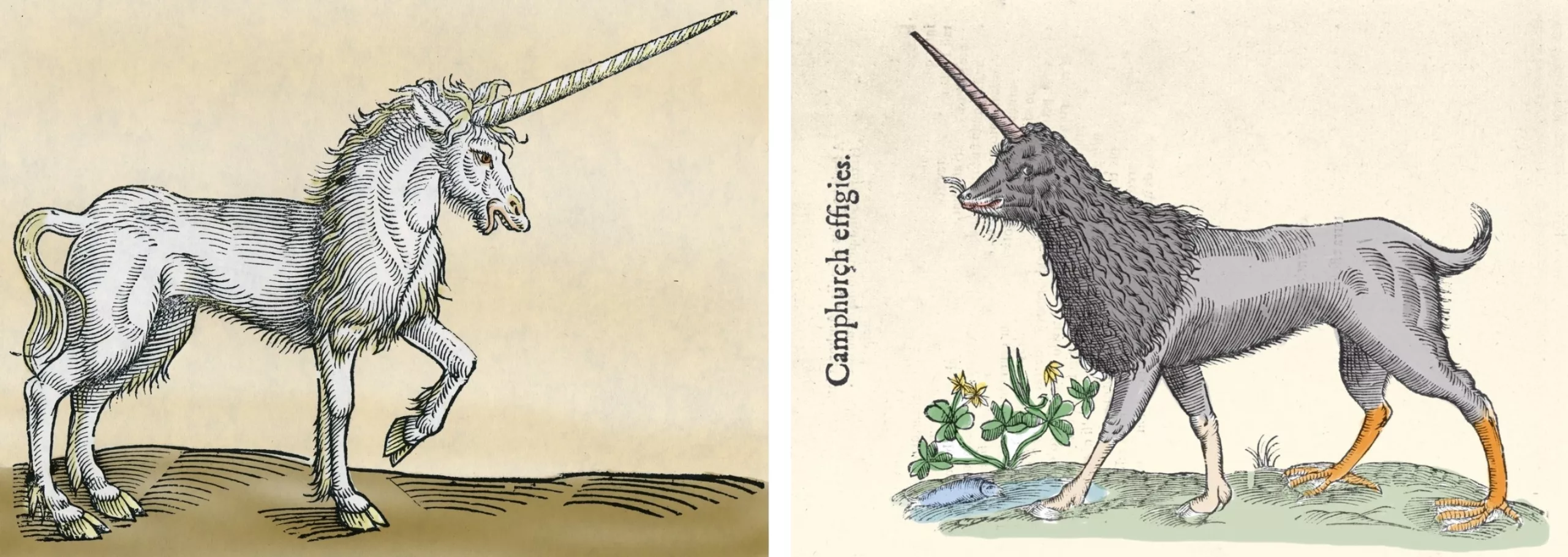
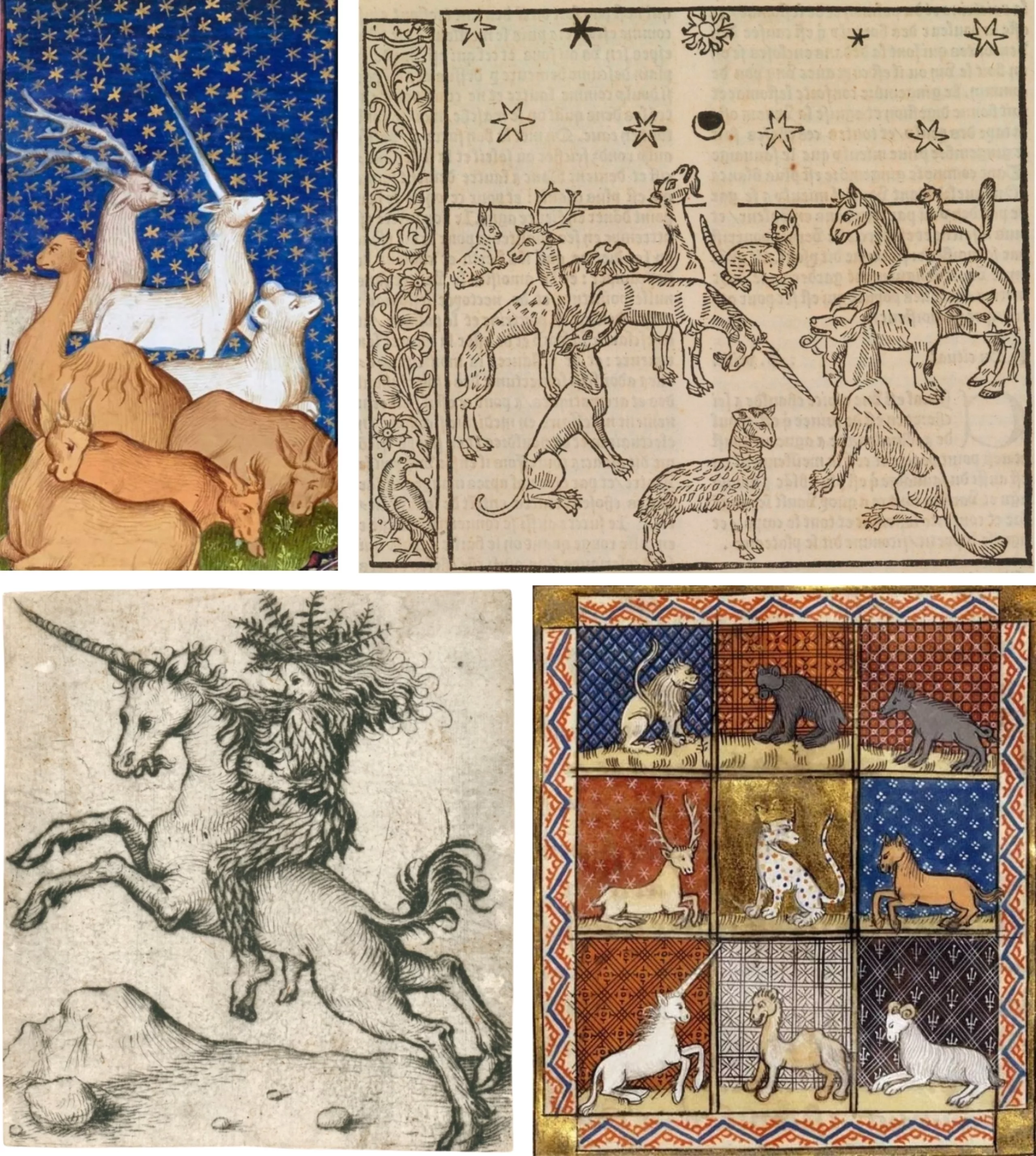
The first, which cannot be taken alive, likely belongs to those species one encounters after eating magic mushrooms. The second resembles those goateed varieties that would flourish in the Middle Ages. The third seems to descend from that extinct species once seen in Siberia, mentioned in the Bible, and which may well have actually existed.
How did a Bible translation turn an ox into a unicorn?
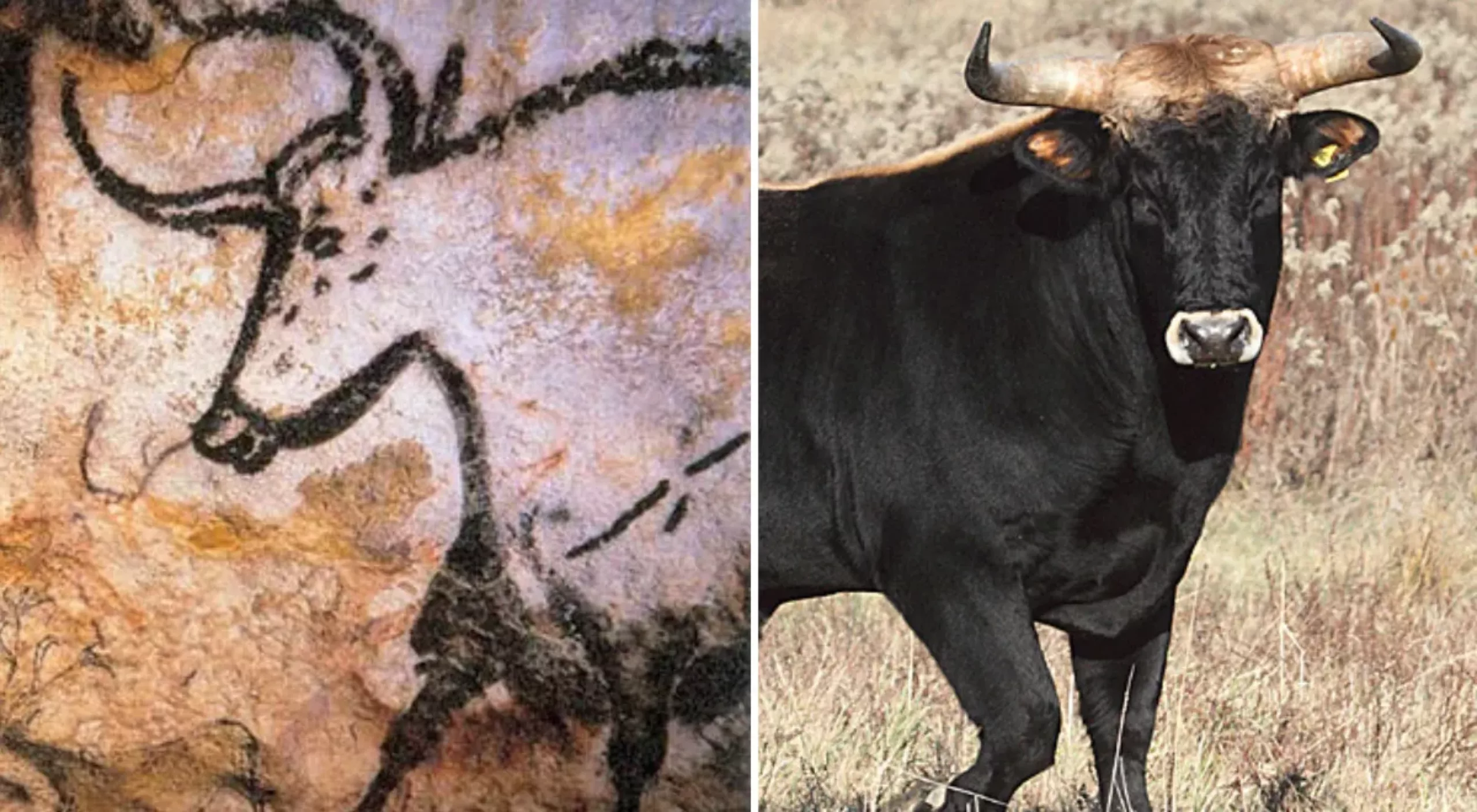
The word unicorn, from the Latin unicornis, derives from the Greek monokeros (literally, one-horned), itself translated from the Hebrew re’em, mentioned eight times in the Bible. This is partly what provided irrefutable proof of its existence, right up to the Renaissance. The term re’em is a proper noun descending from the Akkadian rimu and in fact describes an aurochs, an imposing black ox several metres tall, which disappeared in Poland in 1627, precisely when the unicorn was becoming a mythical animal. Coincidence?

The aurochs has two horns and bears no resemblance to the slender white unicorn we picture today. Yet the symbolism of its name (and a liberal translation in the Bible) gave rise, as so often happens, to fanciful elaborations that helped spread the myth. The term re’em carries the mystical attributes of the unicorn, since in Hebrew רְאֵם is composed of the letters Resh ר, Aleph א and Mem מ, which together can mean: “the primal power (ר) that carries the divine breath (א) into matter (מ).”
In the Bible, the creature re’em is therefore nothing other than an allegory of the power of God. The unicorn is thus necessarily divine.
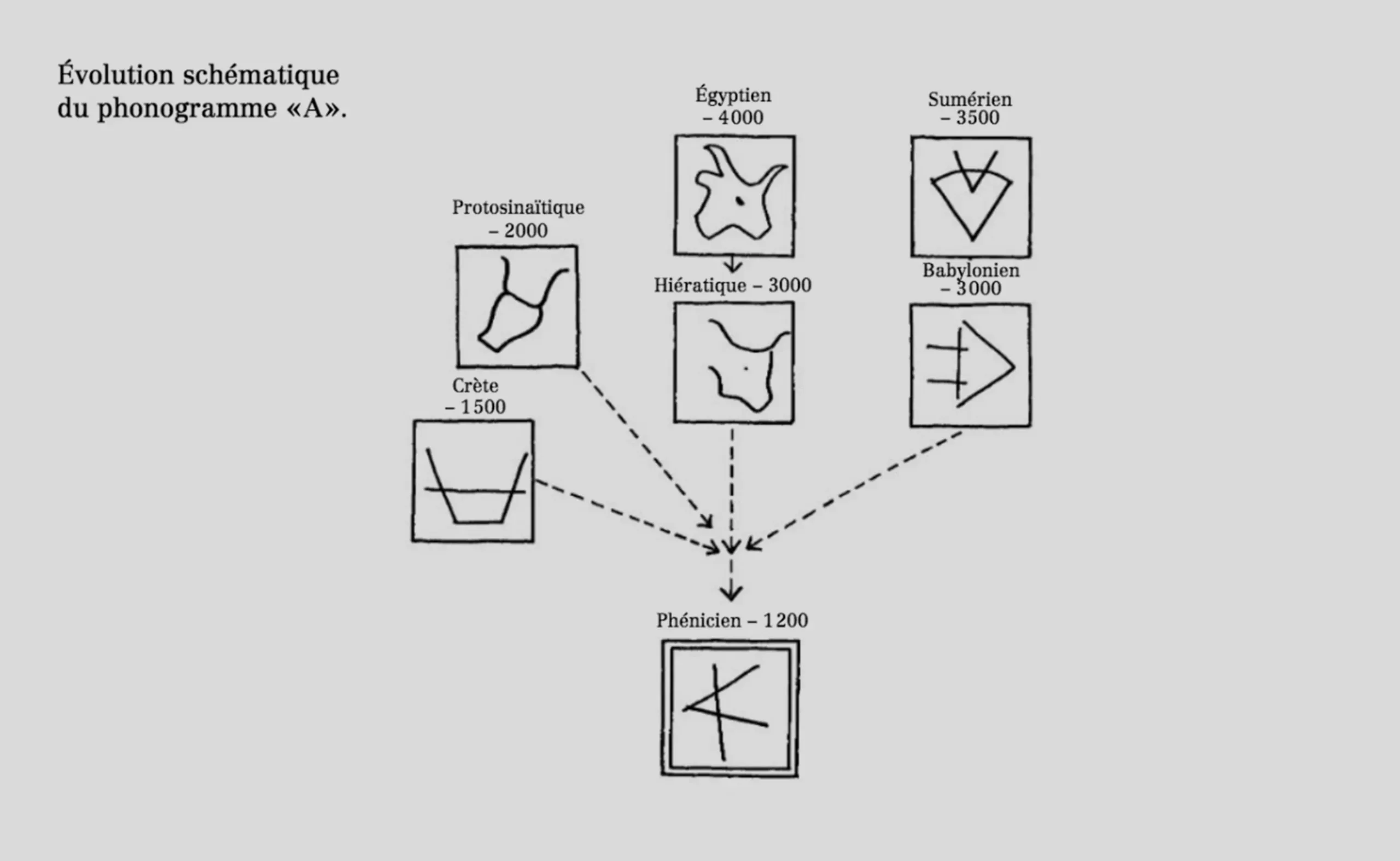
A brief aside: the letter Aleph (א) comes from the proto-Semitic ʾalp = ox. The letter originally depicted a bull’s head, horns pointing upward. In the Phoenician alphabet (direct ancestor of square Hebrew), the shape is recognisable: two oblique strokes with a crossbar, a schematic animal head. The Greeks rotated it and named it alpha. The Romans made it A. The uppercase A, turned upside down, still points toward the two horns of the original bull.
What would our A have looked like if the aurochs had had only one horn?
The unicorns of the Physiologus in the Middle Ages
In the 2nd century CE, the bestiary of the Physiologus (which would become a medieval bestseller, translated into Latin as early as the 4th century, then into Ethiopian, Armenian, Syriac, Arabic, Old Slavonic, Middle English, German, French, Provençal, Icelandic…) describes the scene of the unicorn hunt:
“There exists a beast which is called in Greek monocheros, that is to say in Latin unicorn. Physiologus says that the nature of the unicorn is such that it is small and resembles a young goat. It bears a horn in the middle of its head, and it is so fierce that no man can capture it, except in the manner I shall now describe: hunters lead a young virgin maiden to the place where the unicorn dwells, and leave her seated alone in the wood. As soon as the unicorn sees the maiden, it comes to sleep in her lap. It is in this way that hunters can seize it and bring it to the palaces of kings.”

The poor creature, quietly asleep, is thus run through with a lance by the cunning hunters.
An interesting parallel can be drawn with the tale of Ekashringa mentioned earlier; in the Indian story, a wild and holy human child, born of a nymph and raised in the forest with a deer horn on his forehead, is lured out of the forest by a courtesan sent by a king, who seduces him while he knows nothing of the flesh, and he is subsequently housed in a palace.
In the Physiologus, written by monks, the fierce and untameable creature called the unicorn is drawn into the forest by a virgin maiden, falls asleep in her lap, and is thus captured and brought to the palace.
The courtesan of the original tale was therefore transformed into a virgin, in service of the chaste morality of Biblical texts.

The Unicorn, Christ and the Virgin Mary
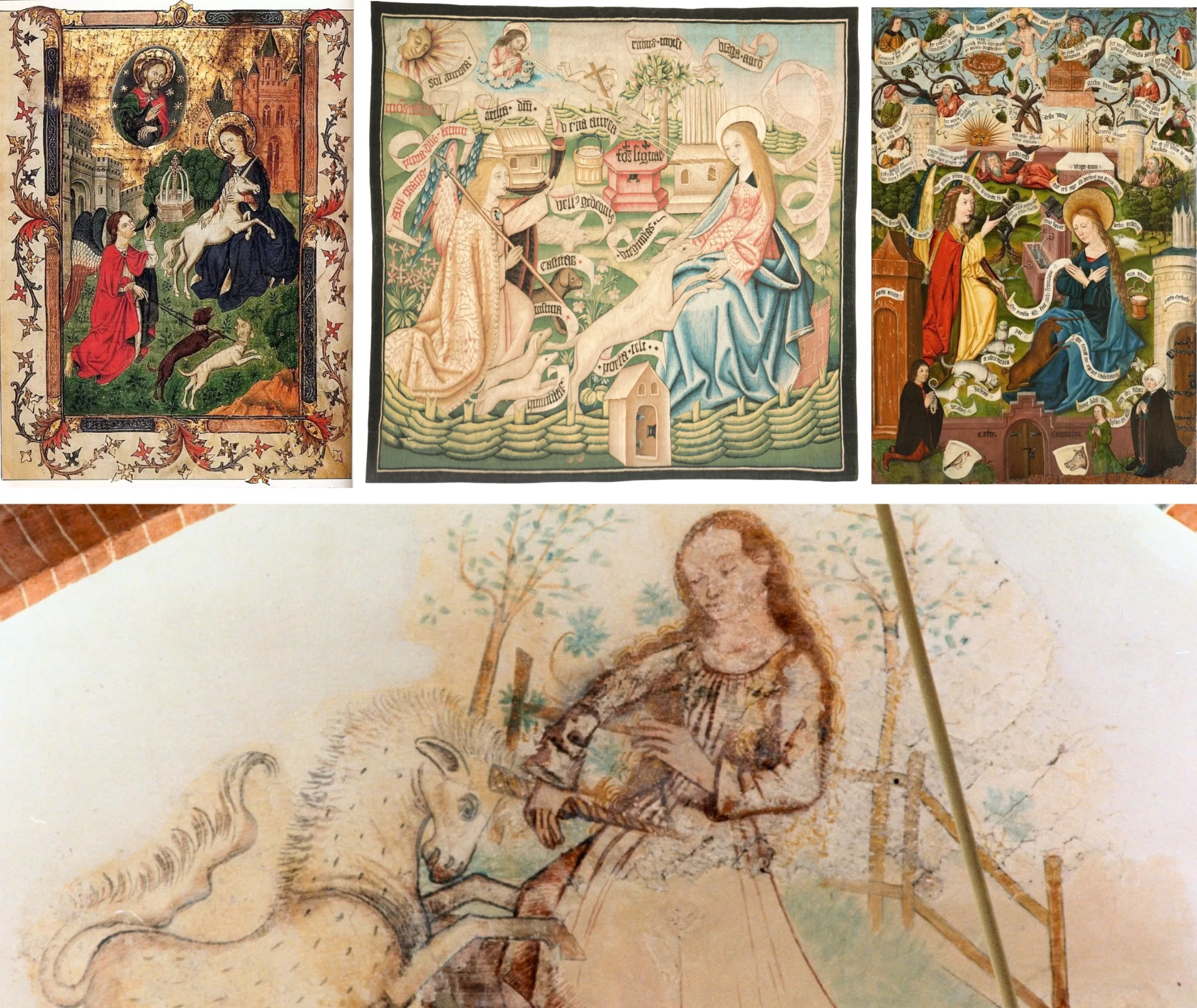
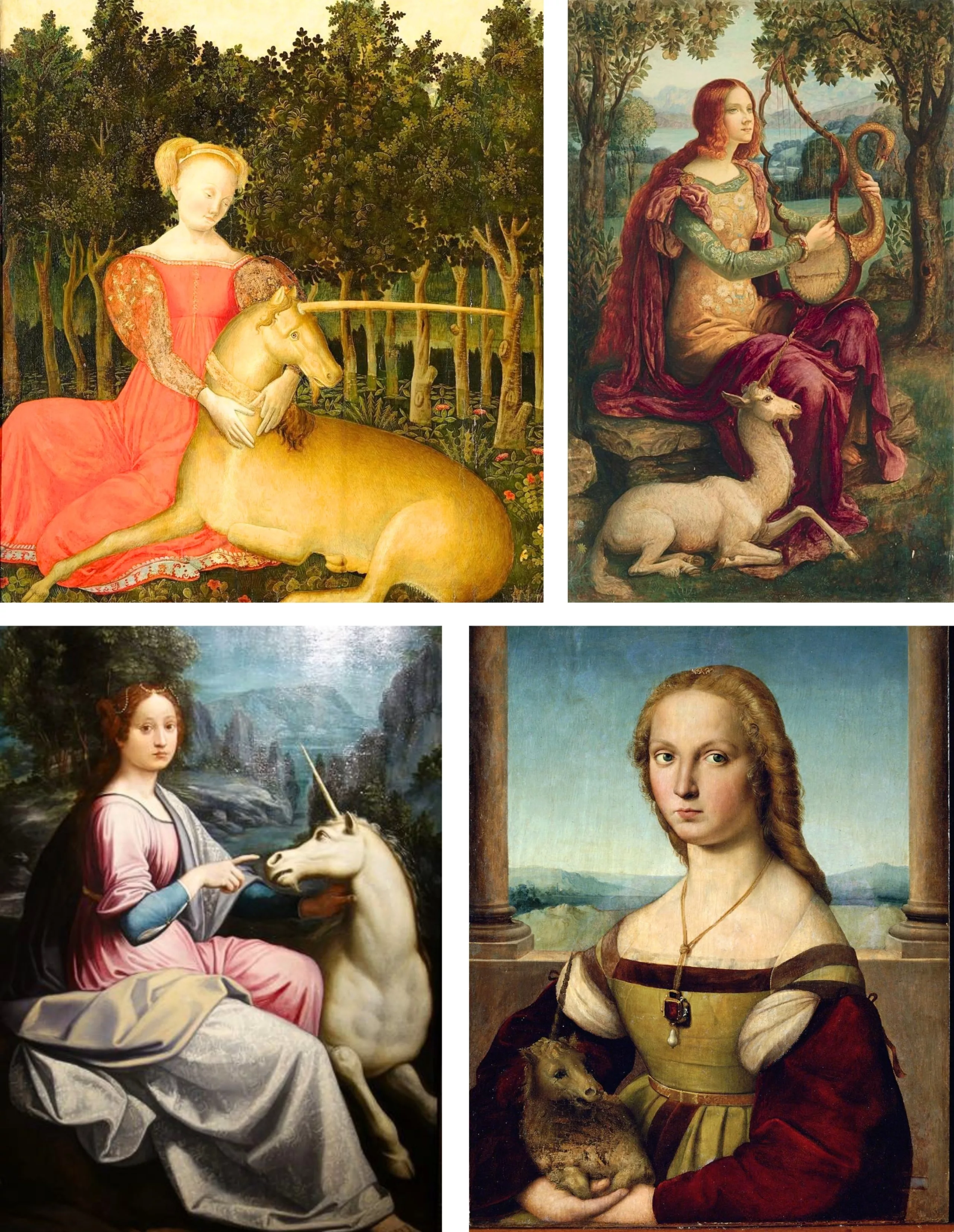
Ever solitary, fierce, wild… no one can seize it. No one, except a pure-souled virgin. And the supreme virgin is, of course, Mary. The image of the maiden and the unicorn would therefore shift toward an allegory of Christ, transforming the unicorn hunt into a scene of the Annunciation. “Sic est dominus noster Iesus Christus spiritalis unicornis“: “thus is Our Lord Jesus Christ, the spiritual unicorn,” says the Physiologus.
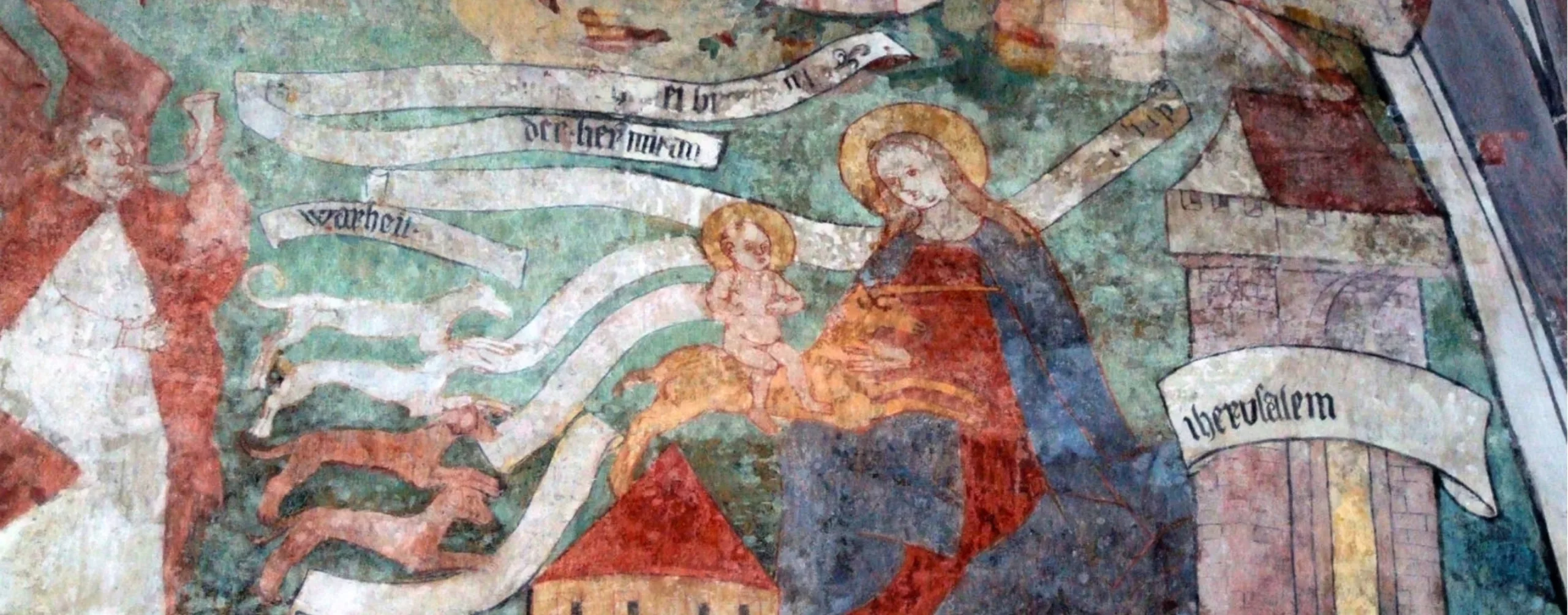
There even exists a fresco depicting the infant Jesus riding a unicorn. The son of the Christian God found himself a worthy mount.
The unicorn is hunted as Christ was during the Passion, its flank pierced by lances. The Angel Gabriel becomes the hunter, with his hounds and his trumpet, and the unicorn, the Word, takes refuge in Mary’s womb. The phallic horn becomes sacred, and its penetration, spiritual.
There even exists a fresco depicting the infant Jesus riding a unicorn. The son of the Christian God found himself a worthy mount.
The Ladies with the Unicorn, icons of chastity
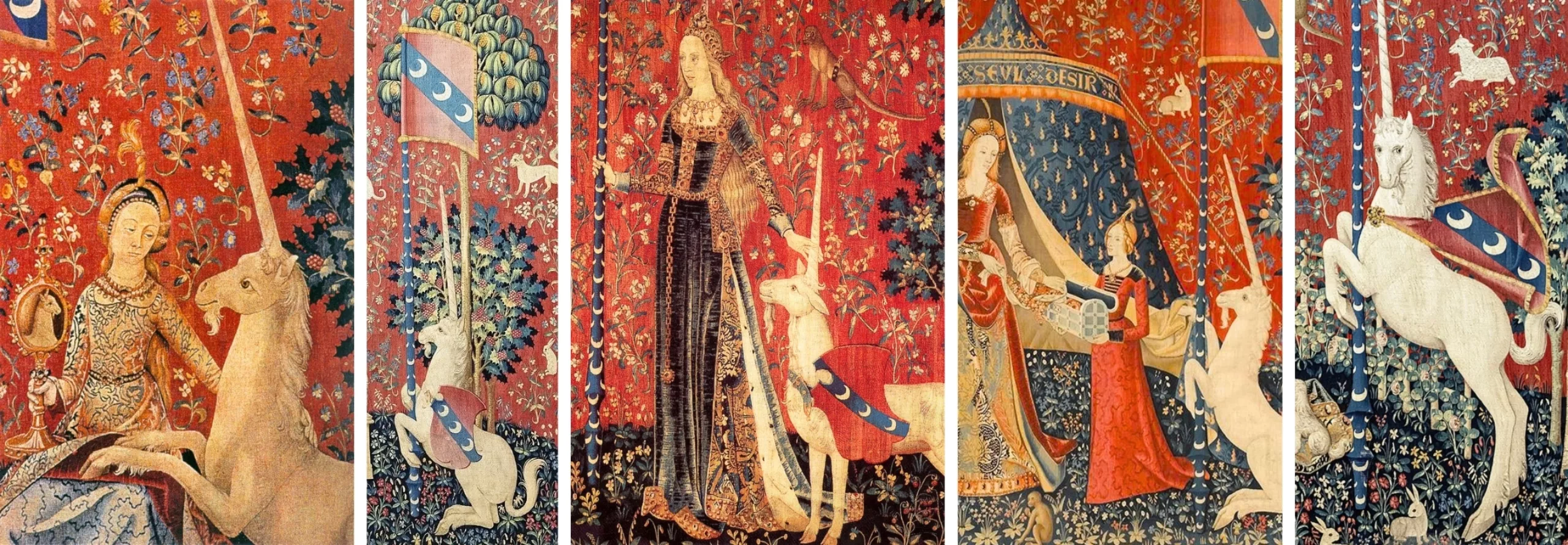
From the 15th century onward, the unicorn would frequently be depicted alongside “ladies”, maidens or young women of eminently pure virtue (unsullied by the sin of the flesh, heaven forbid), who come to stroke the creature with no ulterior motive whatsoever. Such is the case of the famous tapestry of the “Lady and the Unicorn” on display at the Musée de Cluny. Symbolically, the unicorn here embodies raw, phallic and savage force tamed by purity and chastity, and thus the triumph of pious morality over sexual vice. Their innocent, dreamy gaze challenges the viewer.
An effective way to educate the young ladies of the era.
The magical powers and medicinal virtues of the unicorn
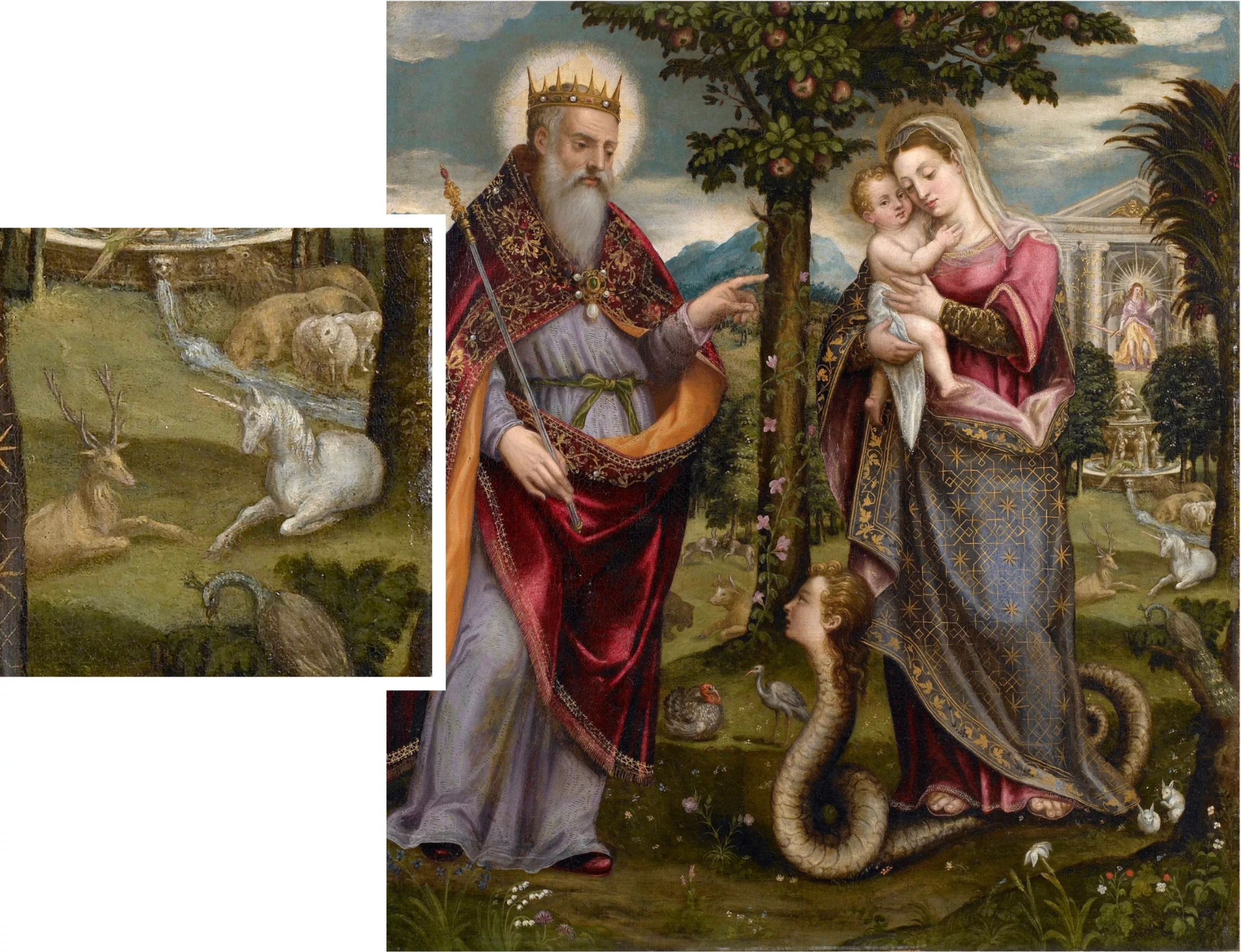
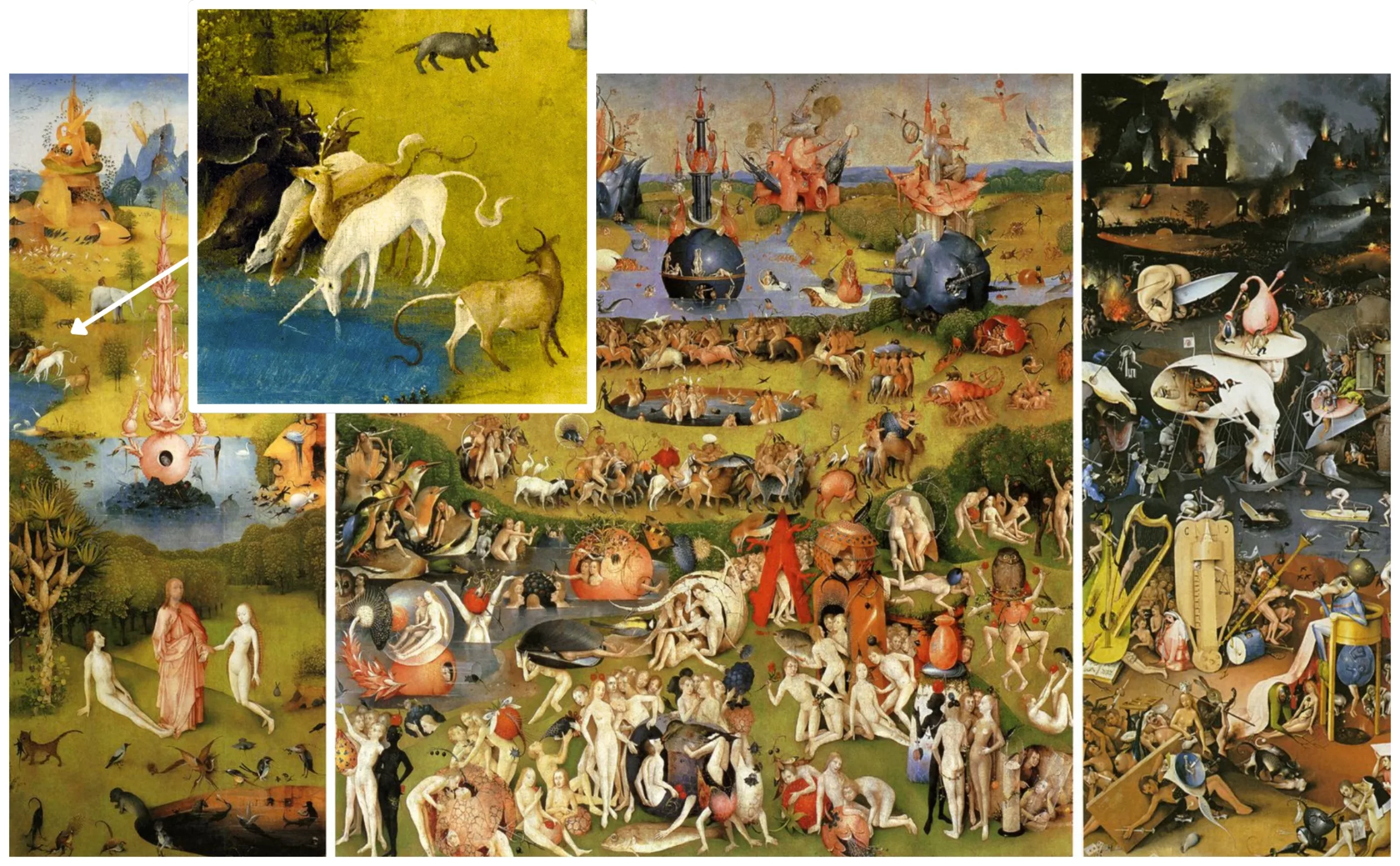
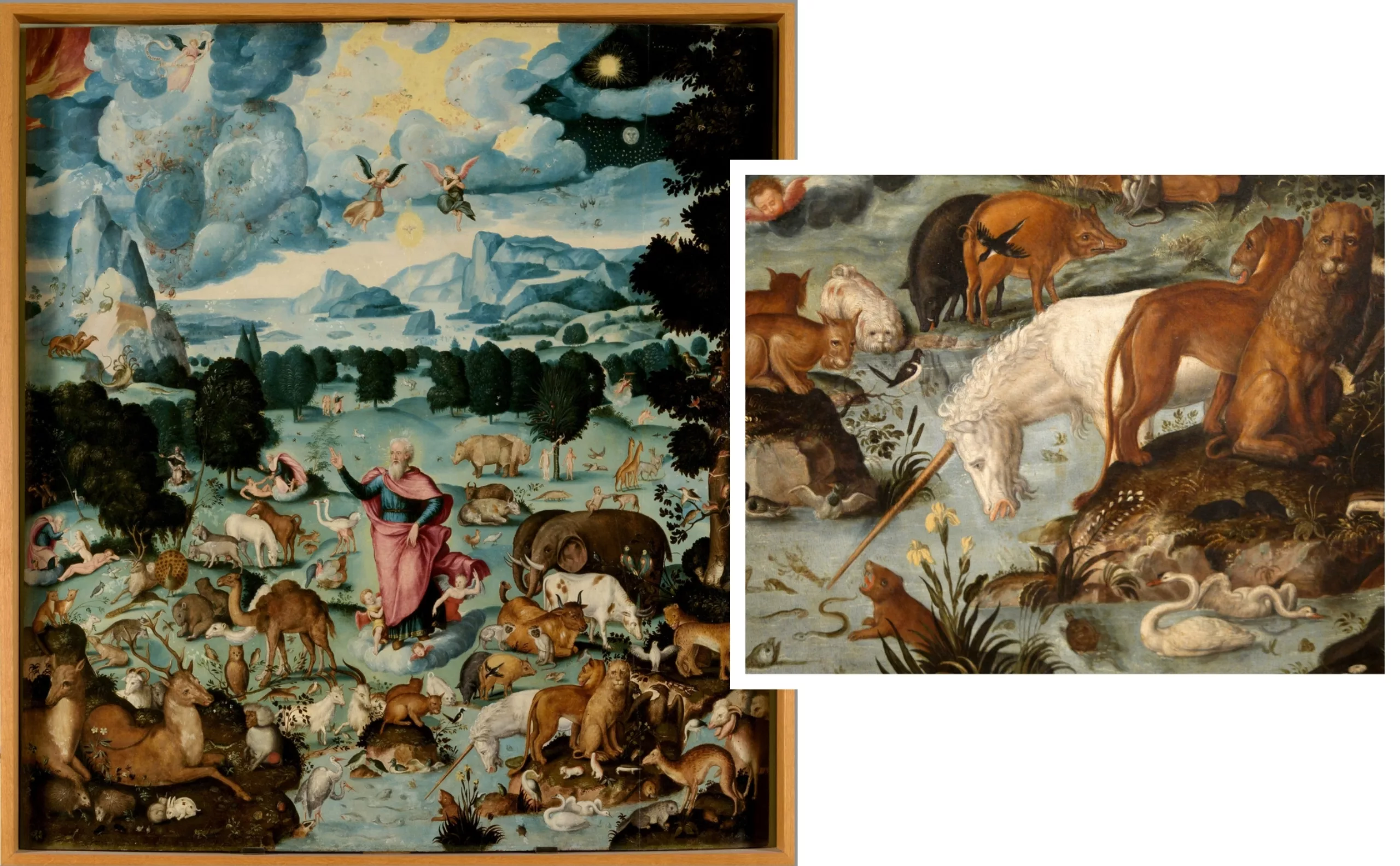
For a long time, the creature was no chimera, since its horn and skin offered genuinely effective remedies (though were they really?) against various ailments. At the Basilica of Saint-Denis, the infirm were given water to drink in which a horn had been soaked. In the 16th century, it was believed that the creature purified water, and it was often depicted head lowered, horn dipped in a stream, or near a serpent in order to draw out its venom. Symbolically, the unicorn is the animal that destroys evil, in the image of Christ, annihilating the serpent. The creature, ever solitary, also features aboard Noah’s Ark (which means it could not reproduce, perhaps explaining why none are seen today).
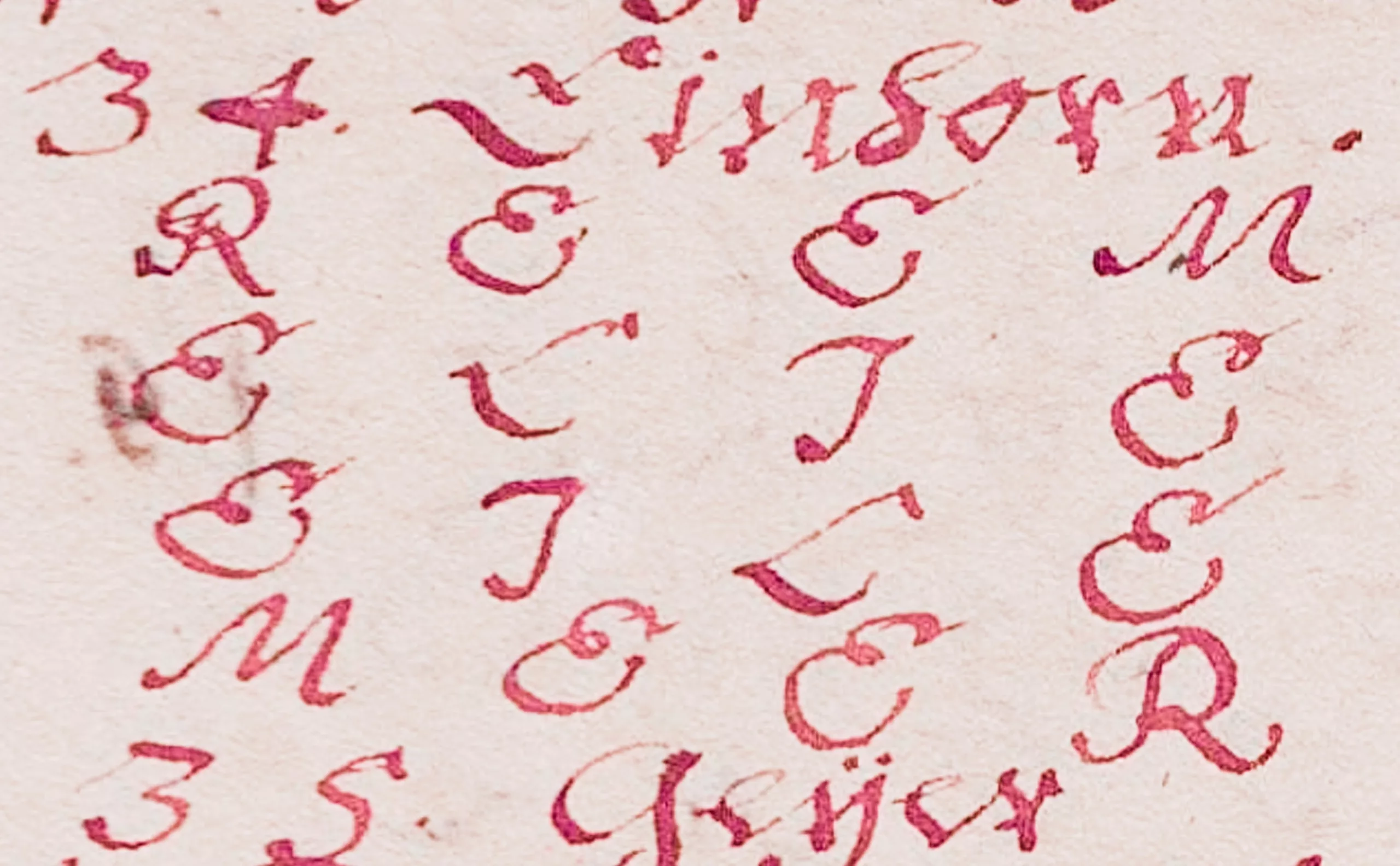
The healer Hildegard of Bingen proposed remedies based on unicorn liver for leprosy. The horn was also said to cure gum disease, stomach ailments, and whiten teeth. In powder form (in reality ground narwhal horn), it was used against plague, measles and rubella, and beyond being a universal antidote, it also possessed aphrodisiac properties. As for shoes made of unicorn hide, they kept foot ailments at bay. Handy. There were also “reem” incantations for summoning unicorns (see illustration below). These were attempted, without success.
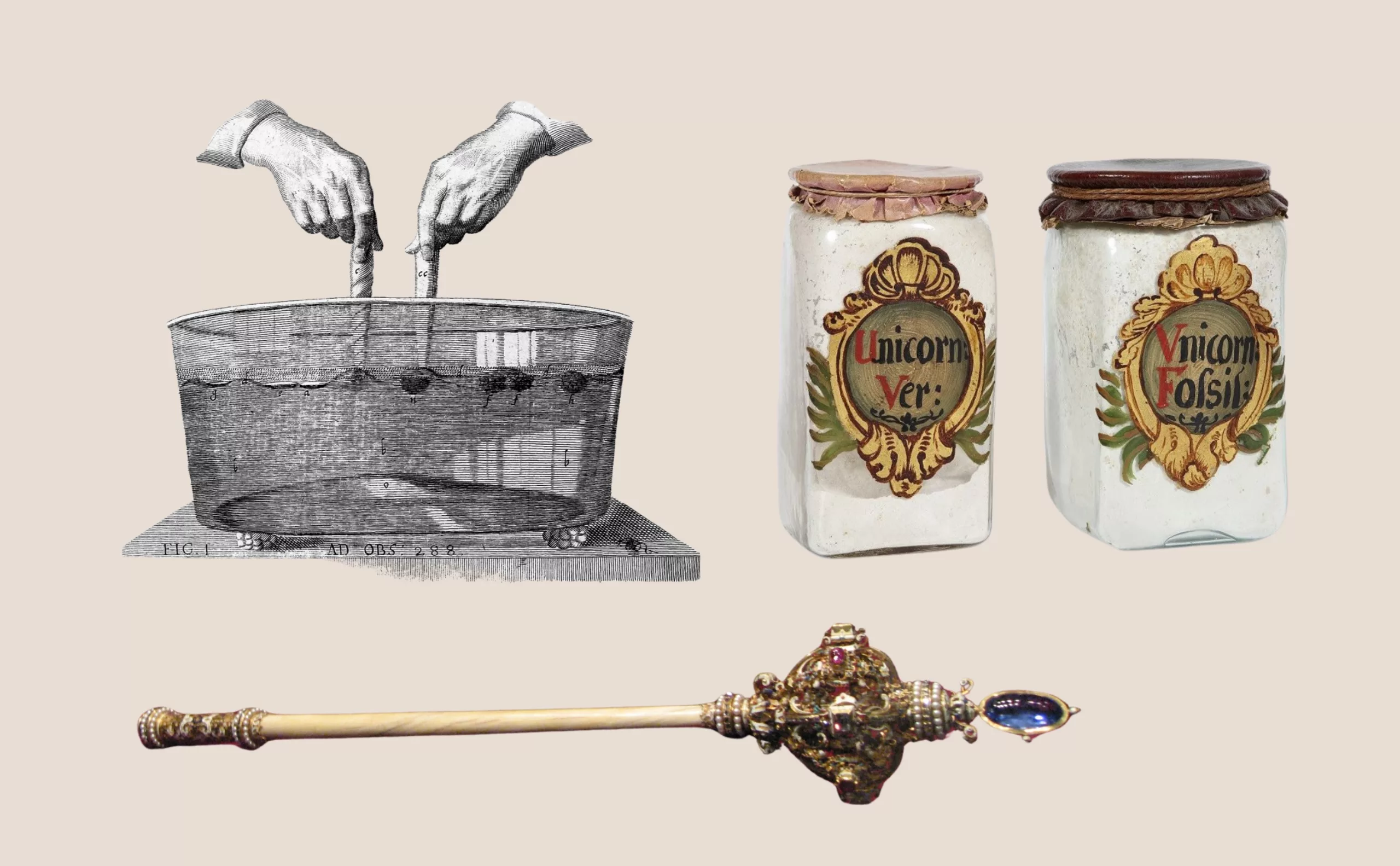
The narwhal-unicorn horn, known as “alicorn”, was sold for up to twenty times its weight in gold during the Renaissance. Owning one was a mark of prestige, displayed prominently in the drawing room to show off (sceptres were made out of them too), or offered as diplomatic gifts, as François I did when he presented one to Charles V. It was also a prize target for thieves.
To test its authenticity, it was submerged in water and was expected to produce bubbles or repel unsavoury and venomous creatures. In the 16th century, the physician Ambroise Paré contested its efficacy, as it had no effect on toads or spiders. The unicorn horn was officially removed from the French pharmacopoeia in 1746, though its use persisted in certain places well into the 19th century!
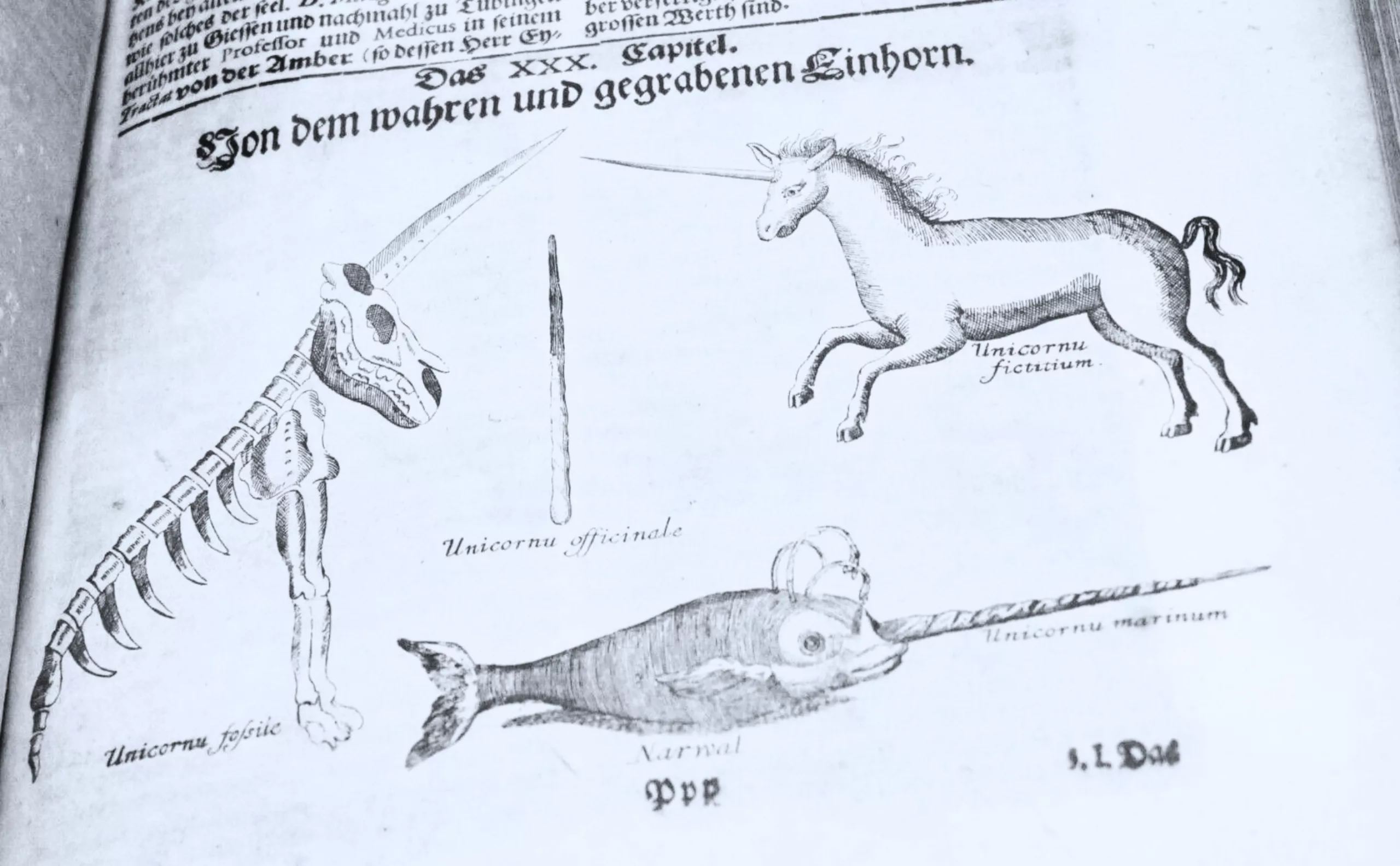
The illustration below distinguishes the officinal unicorn (the narwhal-horn-whose-name-must-not-be-spoken) from the fictitious unicorn, the marine unicorn (the narwhal, which is fine here), and the fossil unicorn (which has no hind legs, probably because no one ever actually saw one in the flesh, though drawing its skeleton creates irrefutable proof).
The heraldic unicorn
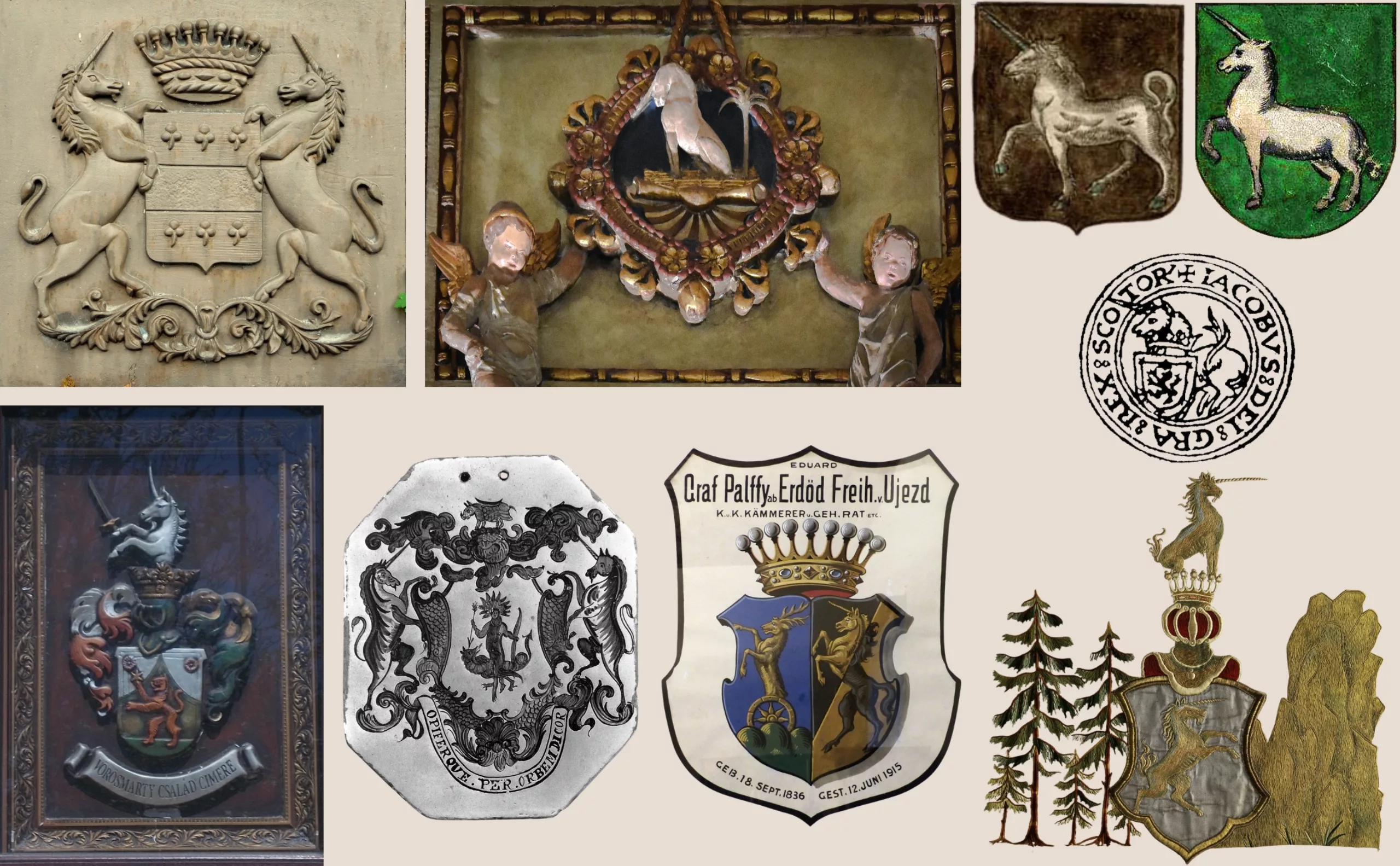
In the 17th century, everyone wanted a unicorn on their coat of arms (Wikimedia Commons has compiled a small collection available here). It was officially the most prestigious creature, the noblest and most virtuous, which also saw off enemies as a bonus. Across Europe, heraldic coats of arms featuring unicorns could be found everywhere, alongside unicorn swords, unicorn ceramic tiles and unicorn wrought-iron gates. With the advent of printing, it became the most represented creature in watermarks and also the favourite of printers, symbolising the purity of paper.
The unicorn icon
With the exposure of the narwhal horn deception, the unicorn crossed over into the realm of fantasy, fairy tales and symbolic allegories. It shed its fierce and Christlike character to become wondrous, unique and magical, before drifting into the kawaii, Japanese-style cuteness. Fantasy made it an iconic creature that continues to captivate imaginations to this day, ever since the New Age era.
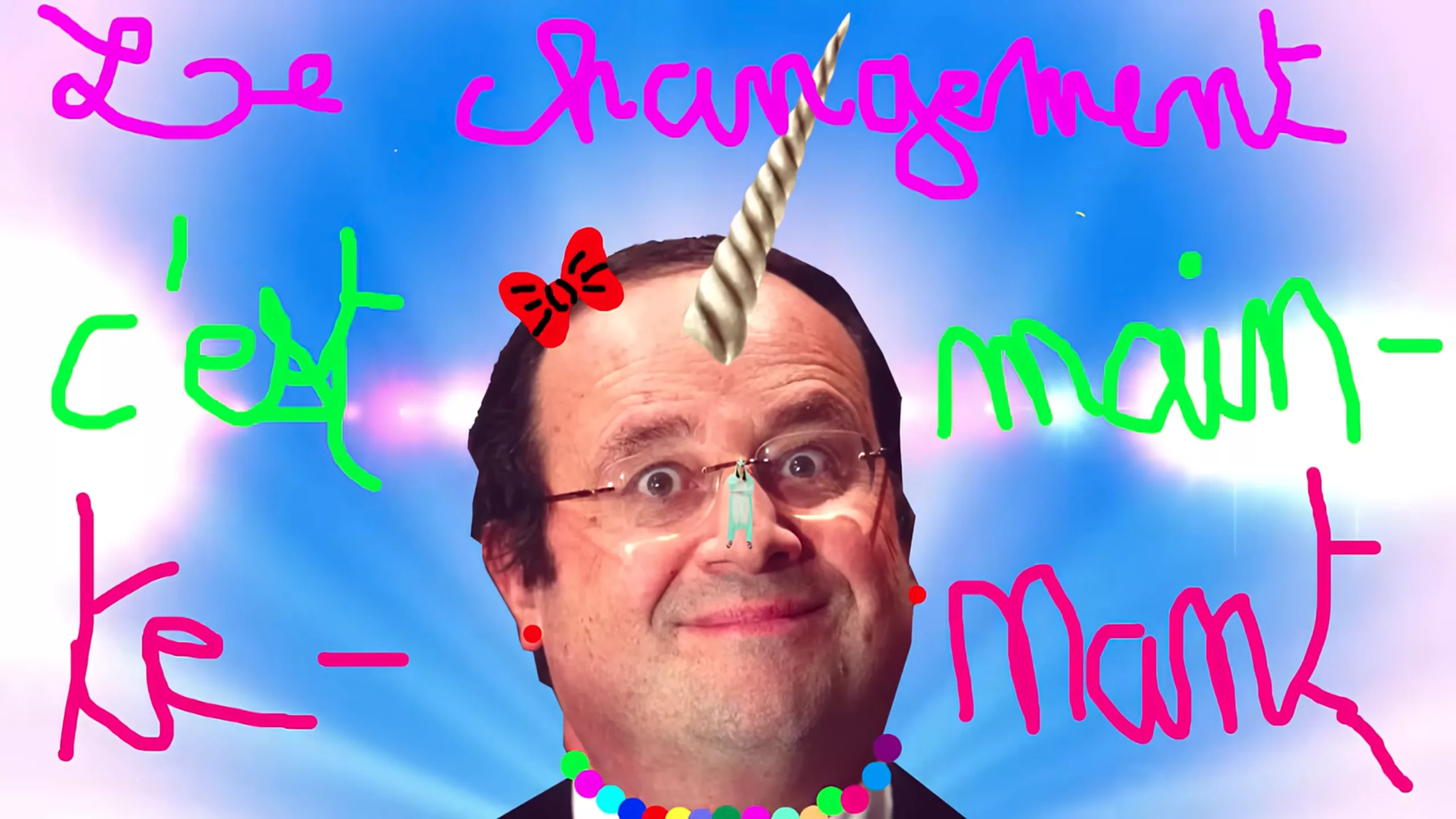
WARNING: if you have read this far, the increasingly questionable visuals may be starting to hurt your eyes. Graphéine accepts no liability for epileptic seizures.
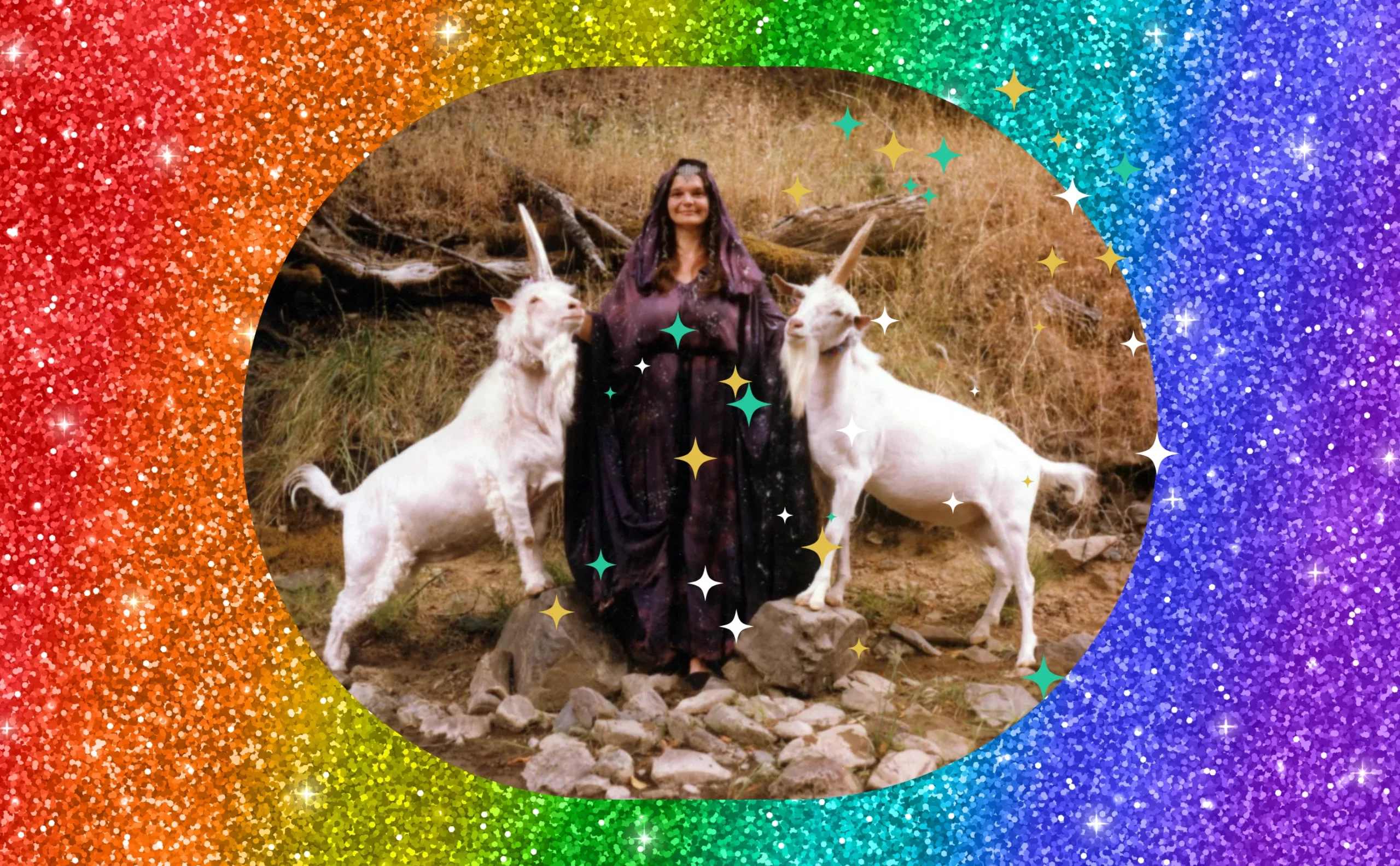
Unicorns existed!
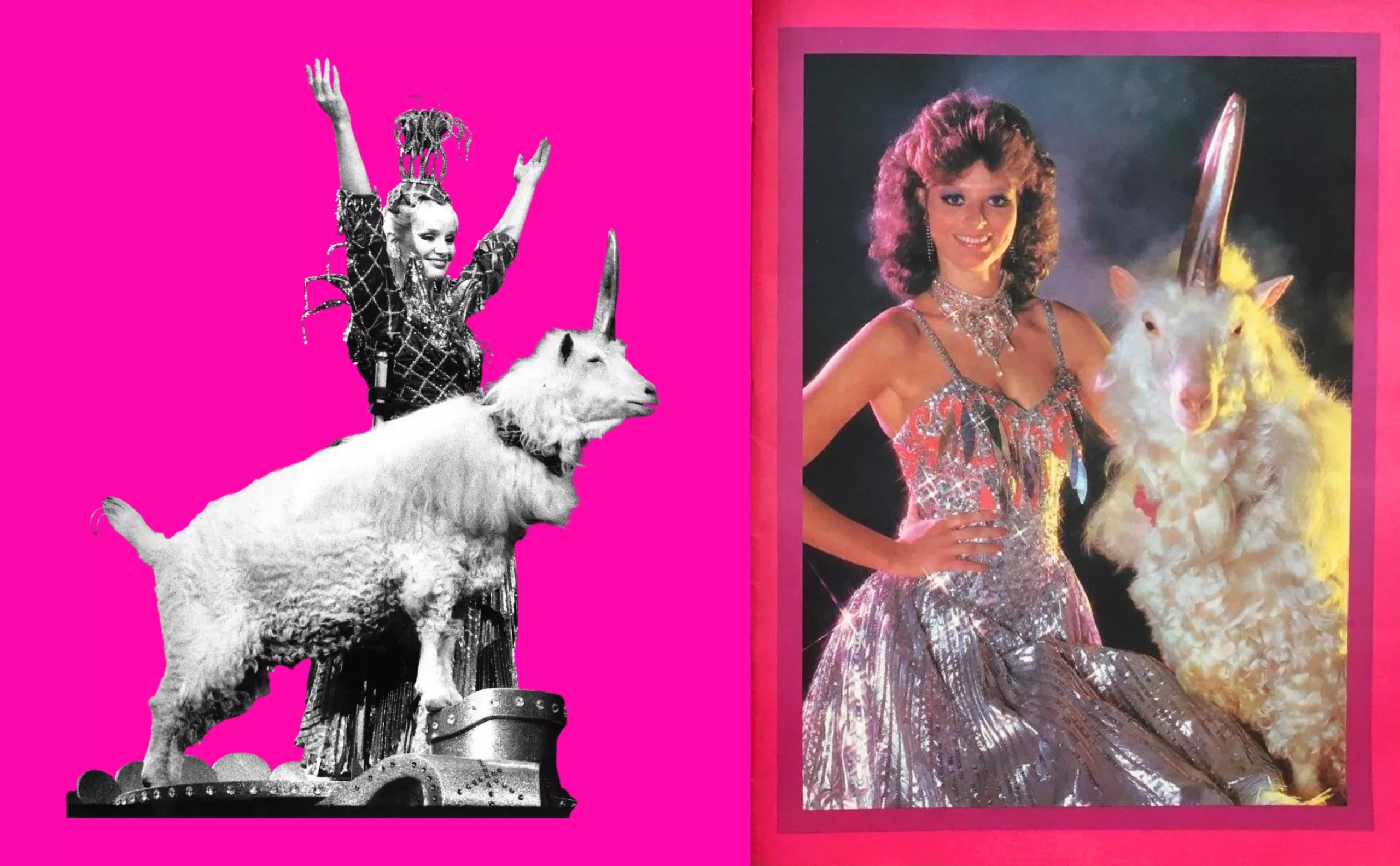
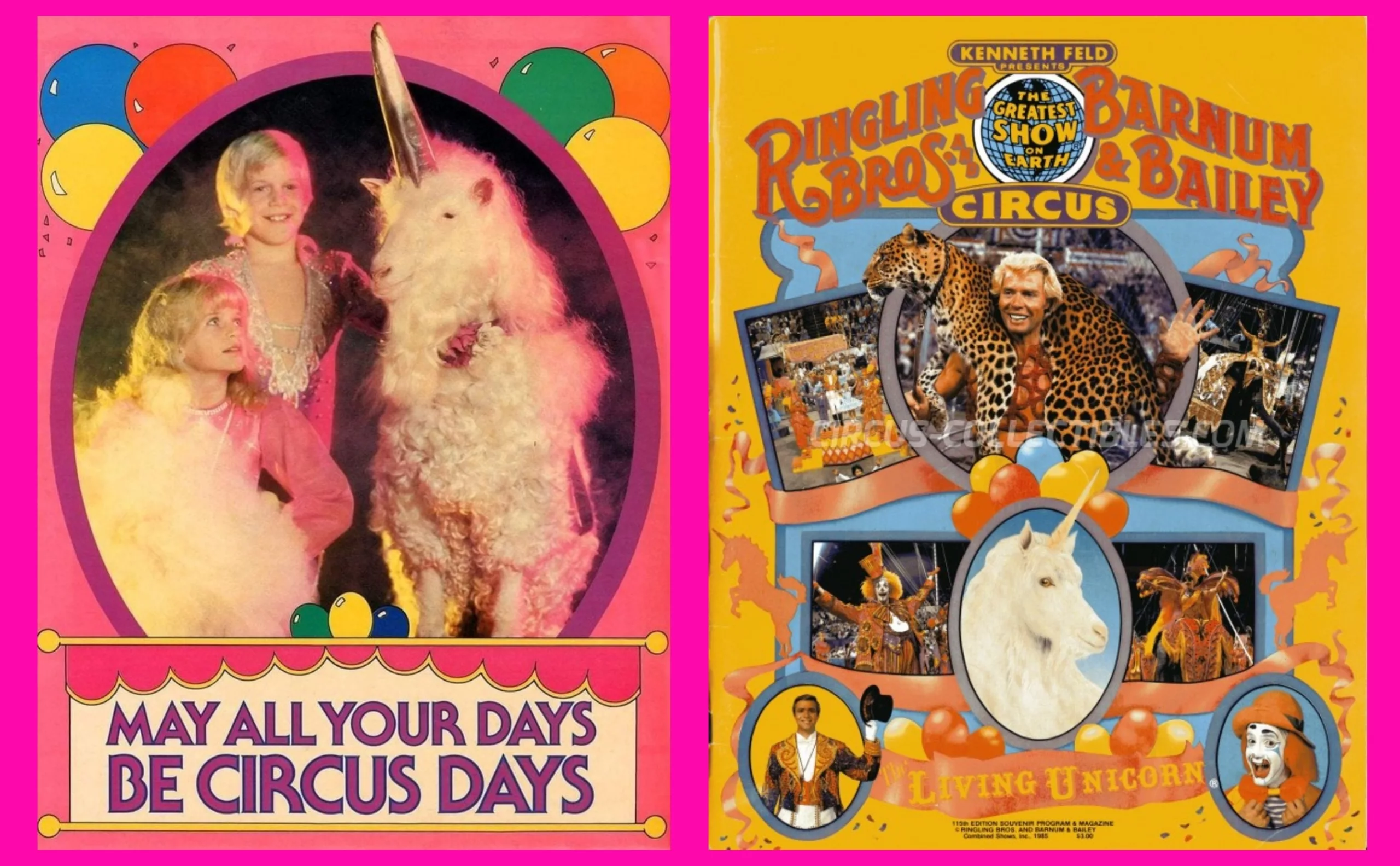
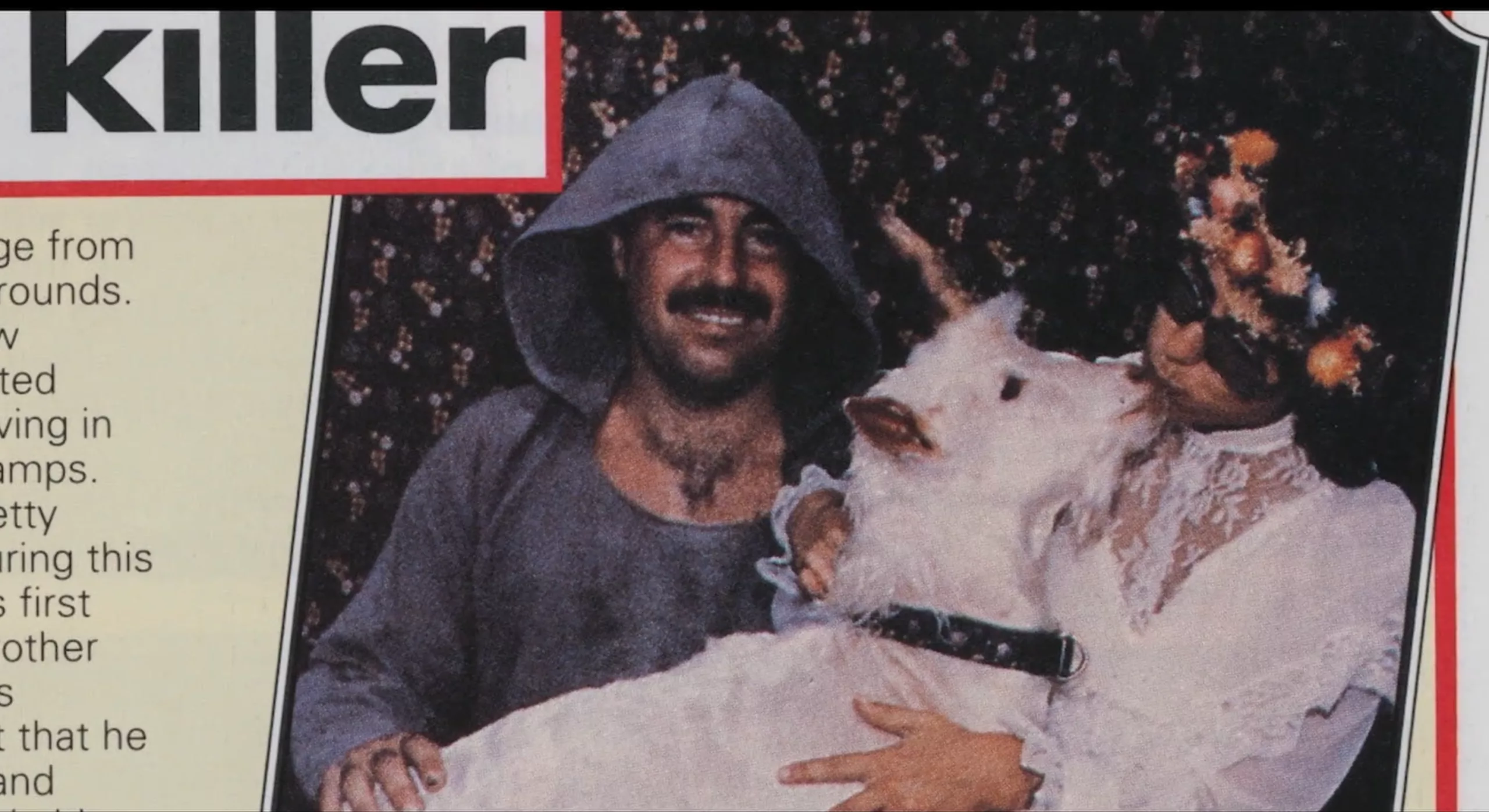
In the 1970s, a couple with esoteric practices discovered a technique for growing a horn in a precise location, and decided to create a unicorn farm. The couple signed with a circus for four years and staged a show featuring two “real” unicorns, which was a massive hit. The fairy tale ended when their neighbour, who had photographed their unicorns, turned out to be a serial killer who had buried some twenty people in his garden. In the press, his photograph showed him cuddling a unicorn. Farewell magic, farewell unicorns.
The unicorn, an antidote to gloom
In the 1980s, children discovered the manga Unico at the cinema, “the unicorn capable of making everyone happy”. Ten years later, the craze for little ponies and rainbows propelled the unicorn into toy shops for little girls. It was “feminised” with pink, a long mane, and copious amounts of glitter.
It still stands proudly in the windows of ice cream shops.
The unicorn is no longer associated with physical healing, but now offers an antidote to ambient gloom.
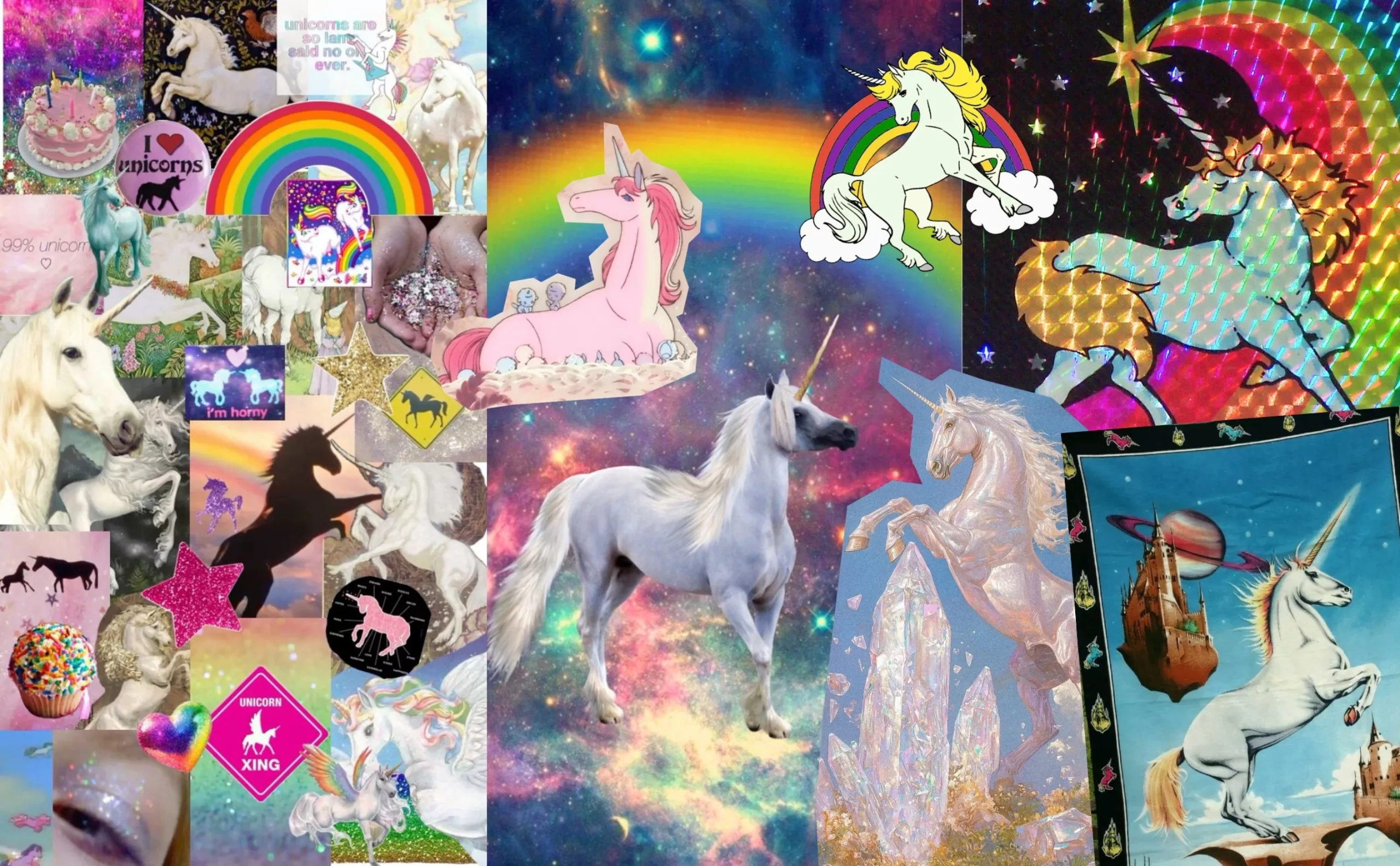
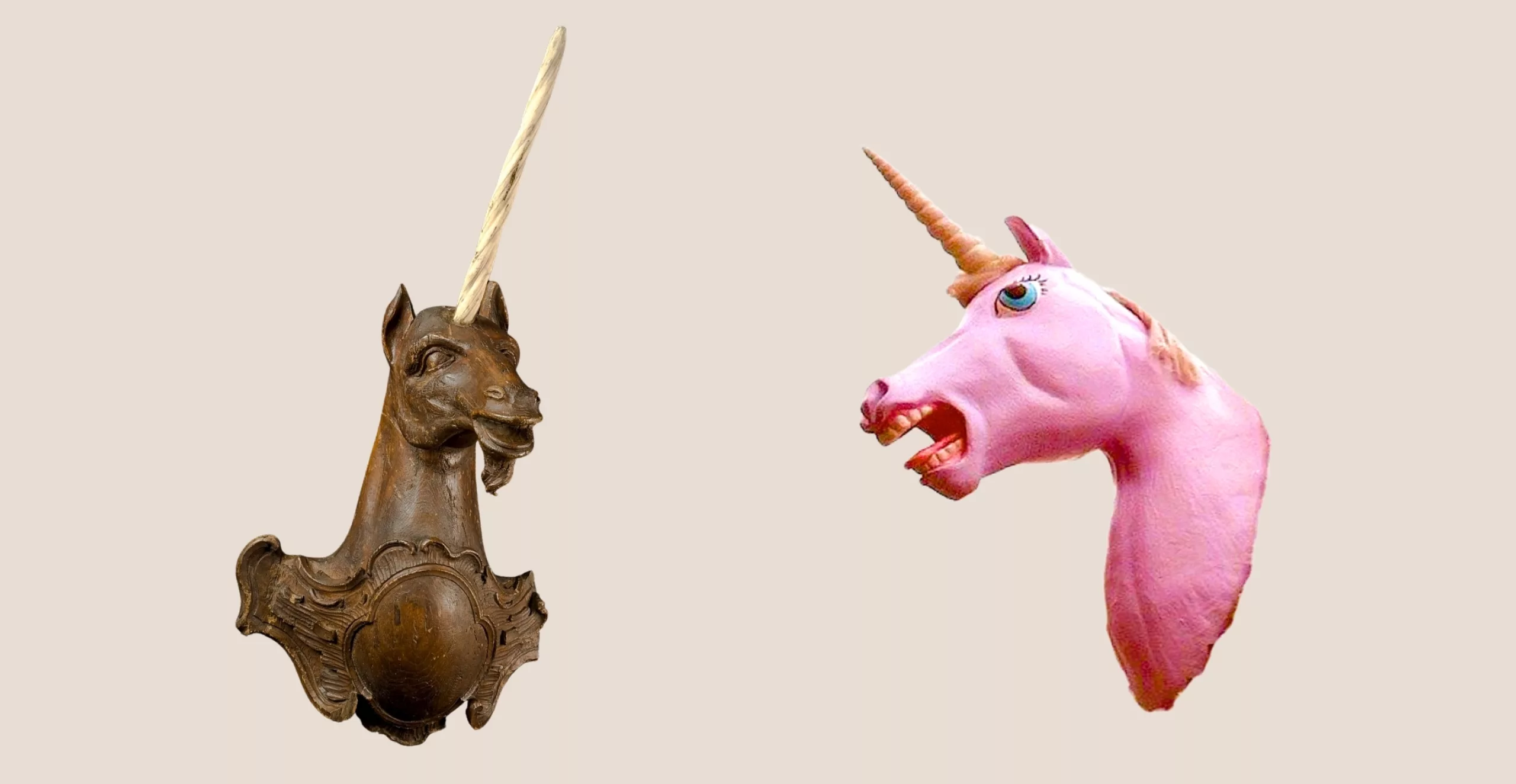
The rainbow pride unicorn
And where there are rainbows, there is the LGBTQIA+ community, which adopted the rainbow flag in 1978 for the San Francisco Gay Pride Parade. The unicorn now embodies the demands, diversity and pride of this community. Unicorns are seen as creatures that carry within them androgyny and self-affirmation, blending so-called “masculine” attributes (strength, the phallic horn) and so-called “feminine” ones (the long mane, grace) in a certain fluidity of gender. The unicorn has become a powerful symbol of resistance against social norms, inviting freedom and the pride of being oneself, being unique, special, and shining brightly. Adding a little glitter to one’s life, in short.
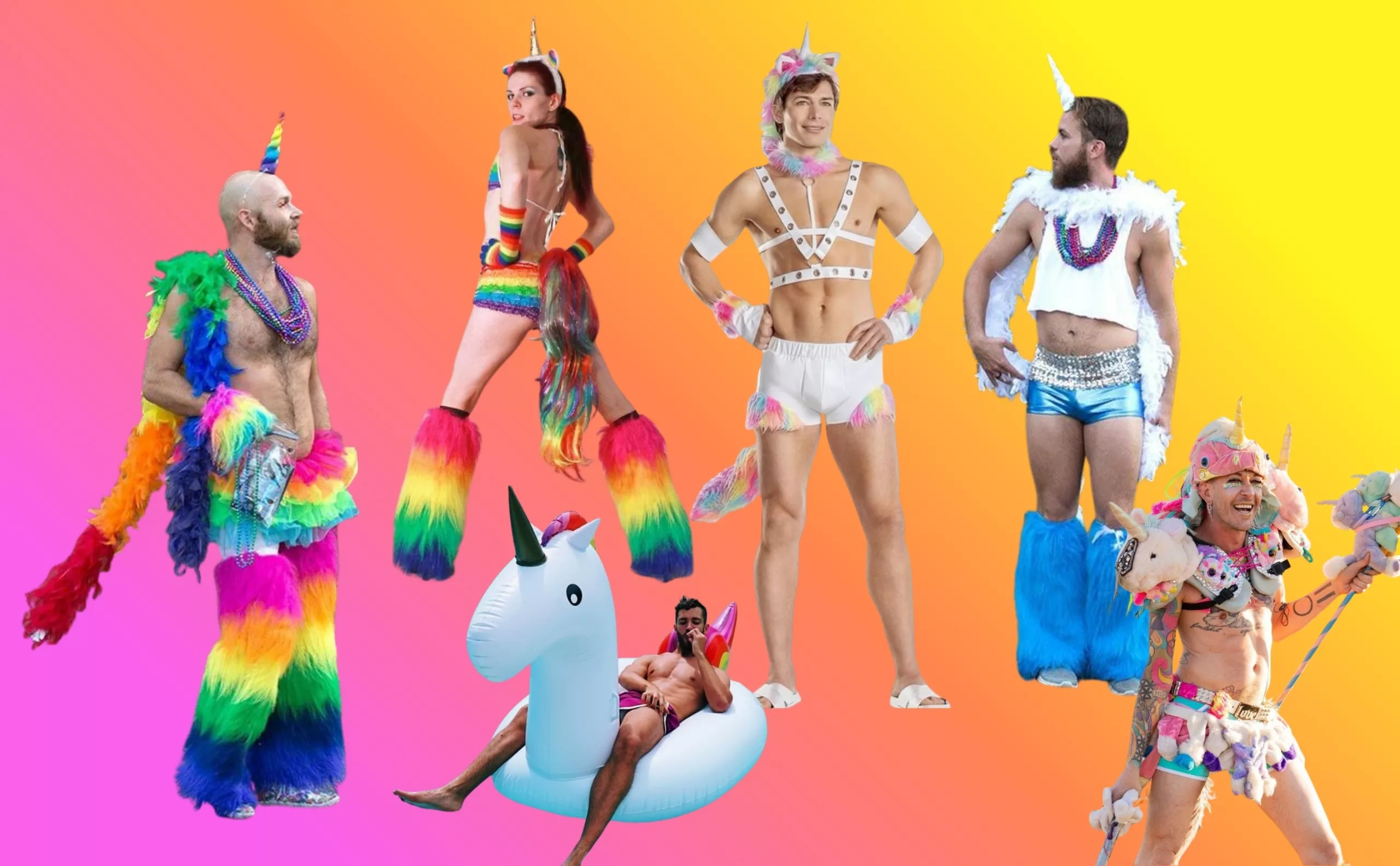
On the fashion side, the icon has inevitably been co-opted by capitalist society, which has made it an ideal accessory for festivals and fancy-dress parties, as well as on the catwalks. Danny Reinke has just created a unicorn coat for his spring/summer 2026 collection, evoking the donkey-skin coat, but shinier. Others use it to sell toilet seat risers, or Gin as “unicorn tears.” In truth, anything remotely connected to the unicorn universe seems highly successful. It is used to describe high-flying startups.
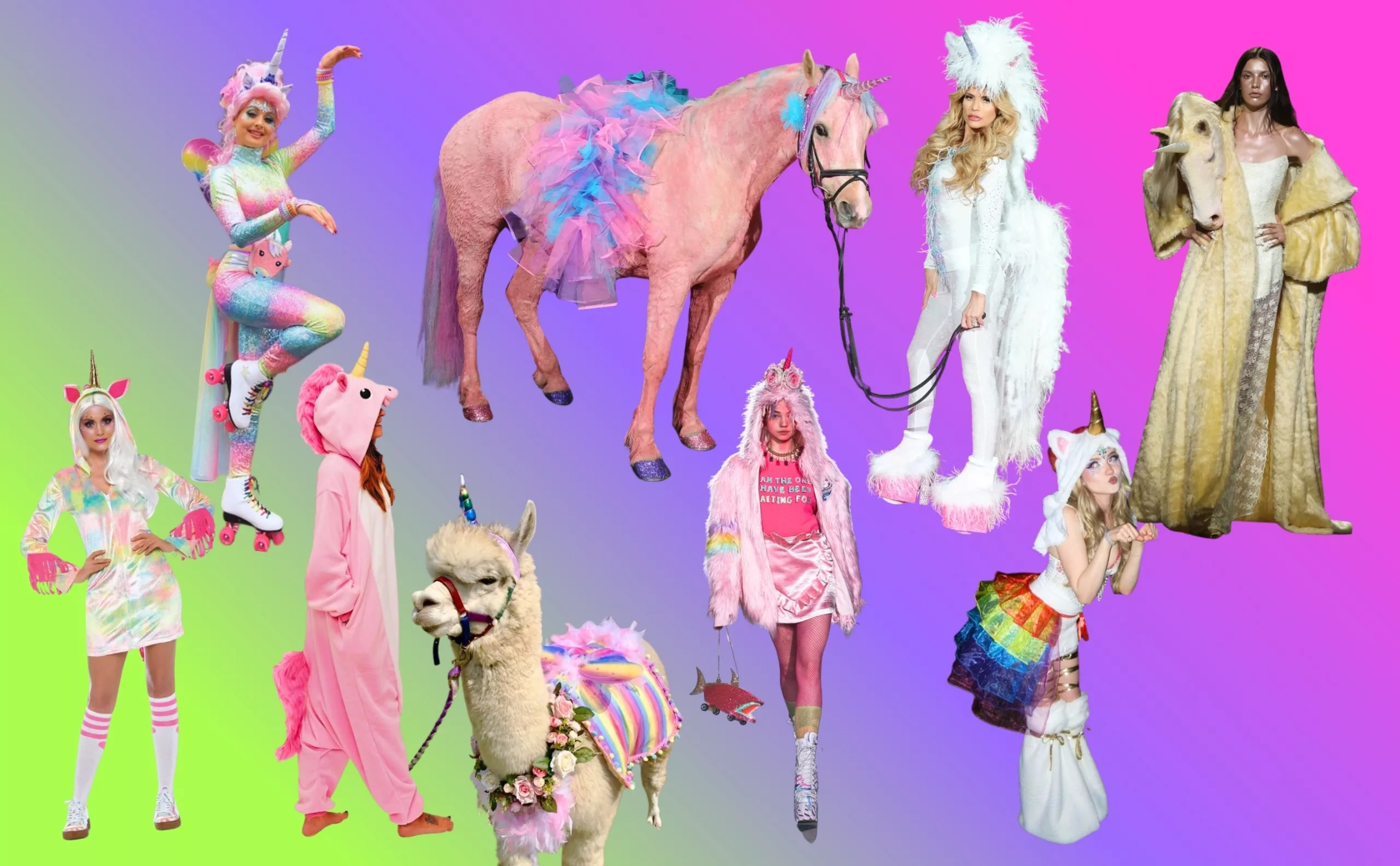
Perhaps there lies the key to the modern incantation of success? The magic of unicorn-marketing rests on a good story that fuels dreams, one that a broad community can hold on to, since all it takes is believing in it to be happy.
Being a unicorn means being exceptional, asserting yourself, breaking down barriers, and not taking yourself too seriously. It means, in short, believing in magic and in the fulfilment of your dreams, however grand they may be.
On the subject
-
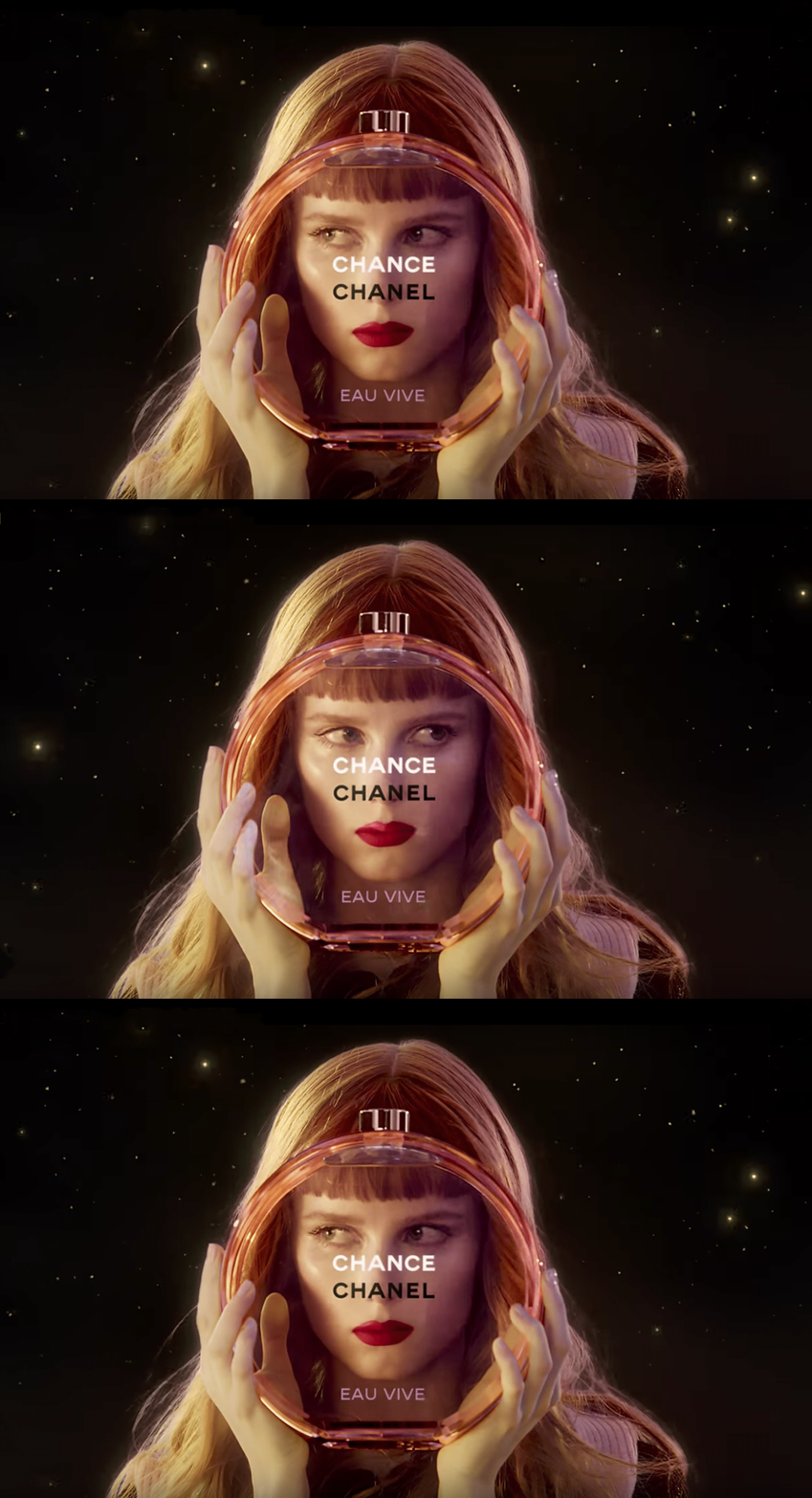
The hidden secret of CHANCE by CHANEL is Goude
Advertising sometimes offers us UFOs that seem to escape simple marketing specifications to project us towards an unexpected elsewhere. Here’s an analysis of the symbolic mystery of Chanel’s latest Chance perfume ad, directed by Jean-Paul Goude in 2016.