Has branding become an amusement park?

Branding, gamification & entertainment
Playful, entertaining and festive elements are emerging as the new trends in visual communication.
In recent years, brand identities have taken on a high-energy feel, constantly evolving, with bouncy typefaces and vibrant colours. Sectors as diverse as an insurer (Alan), a nutrition app (Yazio) and a fintech company (Marblex) – whose slogan is ‘fun comes first’ – are adopting graphic styles that, until recently, were reserved for the worlds of childhood and gaming.
What are we to make of this general trend towards infantilisation sweeping across all areas of design?

The Attention Economy
In 2014, Yves Citton, in *Pour une écologie de l’attention* (Towards an Ecology of Attention), described a world in which human attention has become the most hotly contested resource. In a rapidly changing digital environment, our “available brain time” is monopolised by our screens, their notifications and other stimuli.
… “Available brain time” – the phrase is not neutral and still resonates today with a statement that caused a stir over 20 years ago.
It was 2004, and Patrick Le Lay, then Chairman and CEO of the TF1 group, explained CLEARLY what a television channel like TF1 sells to its advertisers.
“— There are many ways to talk about television.
But from a business perspective, let’s be realistic: fundamentally, TF1’s job is to help Coca-Cola sell its product. However, for an advertising message to be noticed, the viewer’s brain must be available. Our programmes are designed to make it available: that is to say, to entertain and relax the viewer, preparing them between adverts. What we sell to Coca-Cola is available human brain time.”
What Patrick Le Lay points out—and which no one had previously explained so clearly—is that the role of a commercial broadcaster is to work on the space between adverts. A void of meaning, words and images. Almost nothing. A question of attention…

Available brain time and capturing attention.
In 2019, Bruno Patino published a book warning against widespread addiction to social media and other digital apps: *The Goldfish Civilisation: A Short Treatise on the Attention Market*.
And what was Bruno Patino telling us?
That the business model of all web applications is based on capturing attention. That this is not a consequence, but THE starting point for these applications to monetise their activity.
All these applications – in other words, virtually the entire web – are built around a very ancient behavioural mechanism: random reward.

This mechanism was demonstrated by the Skinner box experiment developed at Harvard in the 1930s.
A simple setup. A mouse is placed in front of a food dispenser. The mouse presses the button, and the seeds fall out. The mouse is hungry, so it presses the button, and the seeds fall out. The mouse is in control of the setup; it has fully understood how it works.
Now, the device is deliberately disrupted, and this is where it gets interesting…
When the mouse presses the button, sometimes the seeds fall, sometimes they don’t; sometimes many seeds fall, sometimes very few… The mouse quickly realises that there is an element of chance to the reward and that it does not control the device, but that the device controls everything.
And that’s where it gets stuck; it gets so stuck that the mouse will press the button constantly and become completely dependent on the device. Whether it is full or not, it will continue to press the button.
This is how slot machines in casinos work, and today it is this mechanism of random rewards that lies behind a large number of influential apps such as Facebook, X, Tinder, Instagram and others… Hence a truly frightening predatory aspect.
This obsession with capturing our attention has turned our smartphones into casino slot machines. I like/I share/I like… I click, I click, I click… just like the mouse to get seeds, we tap away all day long, no longer able to control this reward mechanism.
And when we talk about rewards, we’re talking about dopamine; some call it the ‘pleasure molecule’.

But let’s get back to contemporary playful branding.
A logo, a colour palette or a mascot are elements of a design whose primary function is not to inform, nor even to appeal.
And always bear in mind what Paul Rand said: ‘A logo does not need to explain what it represents. If it tries to do so, it becomes literal, dated and fragile. ”.
It is often a matter of capturing and channelling attention in a stream where everything is vying for it simultaneously. Capturing attention effectively, in the present moment.
Capturing attention, not the gaze.
Thanks to our reptilian brain, movement is a powerful tool for capturing this attention. Brands have understood this well, and motion design has become an essential component of any visual identity.
The new rule is that everything must be animated. This is the moment when everyone has entered a race to see who can animate the most to attract attention. In the quest for the ‘Wahoooo’ effect…

This marks the revival of a more “emotional” typography, one that is also dynamic, dancing, moving and transforming.
AI-generated typefaces are coming into their own (see Etienne Mineur), ranging from image-based type to illustrative type. A typography that stands on its own, prioritising visual impact over meaning.
M/M Paris pioneered this trend 30 years ago.

Childhood, infantilisation and gamification
Widespread use of animation and attention-grabbing colours – high-vis colours, fluorescent yellow, hot pink, bright green…
And then there’s gamification.
The term ‘gamification’ has become so commonplace that we might well forget its French equivalent, ‘ludification’. It involves introducing game mechanics into contexts that are not inherently playful: training, work, health, and consumption. The guiding principle is that individuals will be more motivated, more engaged, and even more loyal. Play and the playful world are said to create a strong bond with the customer.

The Yazio nutrition app is a perfect illustration of this approach.
The brand’s rebranding was designed by the London-based studio Koto and goes beyond a new logo: it incorporates a gamified app, challenges, a companion mascot, and a tone of voice shaped by a bespoke language model. Nutrition truly becomes a playground.
The studio sums up the campaign in two words: “Good Dopamine”, repositioning Yazio as a helpful companion that turns habit-forming into a positive experience.
The bespoke typeface was developed by the Croatian foundry Hottype. With its generous strokes, embellished with small, original details (curves inspired by a smile), it fits perfectly with the brand universe created by Koto – a universe that is caring, friendly, accessible and warm.


It’s a bit like the Duolingo owl, a language-learning app.
A creature not exactly known for its mastery of multiple languages, but which has nonetheless become an iconic symbol of a hugely popular app (70 million users).
In 2025, to support Japanese language learning, Duolingo launched its own animated mini-series entitled “The Final Test”, whose universe extended into the app itself.
What we discover here is that Duolingo is no longer content to be merely a learning app. It is becoming a cultural brand and environment, capable of entering its users’ worlds to create unexpected points of connection.


Alan, the health insurance provider, takes this concept a step further with “Alan Play” and its fun challenges: “Walk, meditate, breathe…
Choose your challenge of the day and reap the rewards of your efforts: berries”. In short, earn purple peanuts as points!
The brand, one of whose main functions is to act as a link between a producer and a consumer, becomes more effective by incorporating gamification. By “game”, we mean a journey here, with its levels, progress, rewards and statuses to be earned.
Think of the stars in the Starbucks Rewards programme, or the experience levels of BlaBlaCar members.
Brands have fully grasped the value of creating this “progressive investment” that the user will not want to lose. This is the inevitable “loss aversion”. My 4,500 Starbucks points, my “Ambassador” level – these are all emotional assets that bind me to the brand far more effectively than a discount voucher (After earning 5 stars, you move up to the “Green” level: from now on, your milk foam will be free…).

In addition, we should mention the well-known FOMO (fear of missing out), that fear of missing out on something, exacerbated by random rewards…
This brings us back to “Skinner’s box”. “Exclusive flash sales” are a classic example of this.

Kidults, or ‘adulescents’
The ‘kidult’ phenomenon, a portmanteau of ‘kid’ and ‘adult’, is the other side of the coin.
It is undoubtedly also an idealisation of a time that Gen Z (born between the late 1990s and the early 2010s) never experienced. These were the years before the internet and social media.
This craze is now reflected in the strong comeback of old media formats (vinyl, cassette tapes, VHS, paper fanzines).

In 2024, adults accounted for 29% of toy and game purchases in France, amounting to €1.3 billion. In 2025, King Jouet opened ‘King’Dultes’ stores in Paris, Marseille and Nantes, dedicated exclusively to adults.
In a largely anxiety-inducing world, childlike aesthetics serve as a refuge.
Soft toys for adults, ‘premium’ LEGO sets, Pokémon cards — all of this stems from a quest for comfort found in objects from childhood.
As it does every year, Médiamétrie has published a study on the profile of French people watching television… And here’s a surprise. The average age of viewers of the Gulli channel, a channel created 20 years ago for 3–14-year-olds, is 33… 33 YEARS OLD!!! Whereas for most other channels, the average age is over 50. 65 for public service channels, and 67.5 for Arte. Yes, there is indeed a need for light-heartedness, sensitivity and colour.

Brands have fully grasped this appeal: adopting a ‘pop’, colourful, rounded visual identity means tapping into that emotional register of gentleness and familiarity. It’s a promise, even before anything has been sold, that the experience will be frictionless, painless and uncomplicated.
Cute, cuddly, pretty and colourful. With round, soft and friendly shapes.
The London-based agency Ragged Edge worked on the rebranding of the insurance start-up, Marshmallow.
And we are introduced to a likeable character, Marshall, the pink mascot of a four-year-old. One could easily mistake this project for an educational app for young children.

“Cuddly toy branding”? By pairing insurance with a pink cuddly toy, the message is bound to be welcoming and accessible!!! The risk of controversy or negative publicity naturally fades away. (See our series on mascots!!!)
The “cute” Care Bears style is nothing new. What is new is that sectors where it would previously have been inappropriate to use a “cuddly mascot” can now get away with it.
Childhood and empathetic branding also speak to everyone, regardless of background or social class. Childhood being the lowest common denominator.
Alan, for example, manages to be “serious without projecting a serious image”, tapping into an emotional register that traditional mutual insurance companies had never dared to touch.
Health insurance is, however, a serious matter, involving significant financial and medical decisions. Wrapping it up in a cuddly aesthetic masks this seriousness.
And the question remains open: does this play on seriousness truly facilitate access to care, or does it contribute to de-realising issues that sometimes deserve to be faced head-on?

The creative industries: a factory of obsolescence and consent
In this playful design, a paradox seems to be emerging: whilst every brand claims to ‘stand out’ by adopting pop and gamified aesthetics, the result is a disturbing visual uniformity.
The ongoing infantilisation of commercial brands reduces the graphic symbol to the lowest common denominator.
Open Dribbble or Behance and you’ll find the same 3D mascots with puffy textures, the same pastel gradients, the same “blob” typefaces, whether for an insurer or a coffee shop.
Trends have always existed, with their logic of imitation and cycles of distinction and trivialisation, where an initial creative gesture is quickly copied, disseminated and standardised until it loses its power to stand out. Playful branding follows exactly this trajectory.
What was daring at Alan in 2019, when DesignStudio created its first mascot, has become, seven years later, much more commonplace.


Creative industries and education
Finally, another aspect lies in the realm of education and graphic design schools.
Over the past 30 years, and particularly with the exponential growth of private institutions, schools of applied arts have evolved into multimedia schools and, more recently, into training institutions for the creative industries.
What we are seeing emerge before our very eyes is the convergence, the merging of all disciplines around ‘narrative entertainment’.
Thirty years ago, through the work of M&M Paris, Labomatic and H5, we witnessed graphic design opening up to fashion, contemporary art, music and the luxury industries.

Today, we are undoubtedly witnessing a different kind of shift, no doubt fuelled by the ubiquity of digital technology across shared platforms where everything becomes fictional.
It is as though the boundary between communication, visual identity, cultural design, video games, cinema, animation and narrative fiction is gradually disappearing. Some speak of the ‘fluidity’ of cultural fields…
The fluidity of visuals in a world where the intertwining of fiction and reality is at work on screens that level everything.
It is also the ubiquity of the video game industry, which generates more profit than cinema and music combined. For several years now, it has been the world’s leading cultural industry!!! This is an economic reality that must be taken into account, even if the mainstream media only touch upon it occasionally…
Video games now extend far beyond the realm of play alone.

For example, the Collins agency has developed a storytelling approach directly inspired by science fiction comics and the world of Moebius for the online brokerage platform Robinhood.
In 2013, Robinhood’s ambition was to make the world of finance accessible to everyone and enable all small investors to trade like professional traders. “We are all investors”.
This raises the question of playfulness in high-risk sectors such as banking investments, which have been democratised for over a decade for Gen Z through digital currencies (bitcoins) and NFTs.
But perhaps the most emblematic example is the London-based agency Pentagram’s work on the new Harry Potter Quidditch Champions series. The fact that an iconic agency like Pentagram, which has specialised in corporate design for 50 years, is working for Hollywood, the world’s largest entertainment industry, is telling in more ways than one.


Can we really afford to create a visual identity today without making widespread use of gamification? Nothing could be further from the truth…
Narrative branding is becoming essential for all brands, and the logo is merely one element of a universe that tells a story, evokes a fictional world, and creates a certain atmosphere.
There is no escaping the need to tell stories…
If not utopian, the future will be gamified, playful, narrative and colourful… !!!
Written by: François Chevret
Further reading…
Yves Citton, ‘Pour une écologie de l’attention’, La Découverte, 2014
Bruno Patino, ‘La civilisation du poisson rouge, petit traité sur le marché de l’attention’, Grasset, 2019
Koto Studio, “Yazio — Good Dopamine”, 2026
Theodor Adorno and Max Horkheimer, “Dialectic of Reason”, 1944
Mourad Bofala, “Contributing to employee learning: the role of gamification”, thesis, University of Corsica, 2022
Franck Bouchet, “Play: futility, necessity” — Preliminary clarifications, Académie de Nancy-Metz
Christian Barrère, “The links between culture, cultural industries and creative industries”, Centre Pompidou, 2006
Yohann Douet, “Gramsci and mass culture”, 2023
On the subject
-
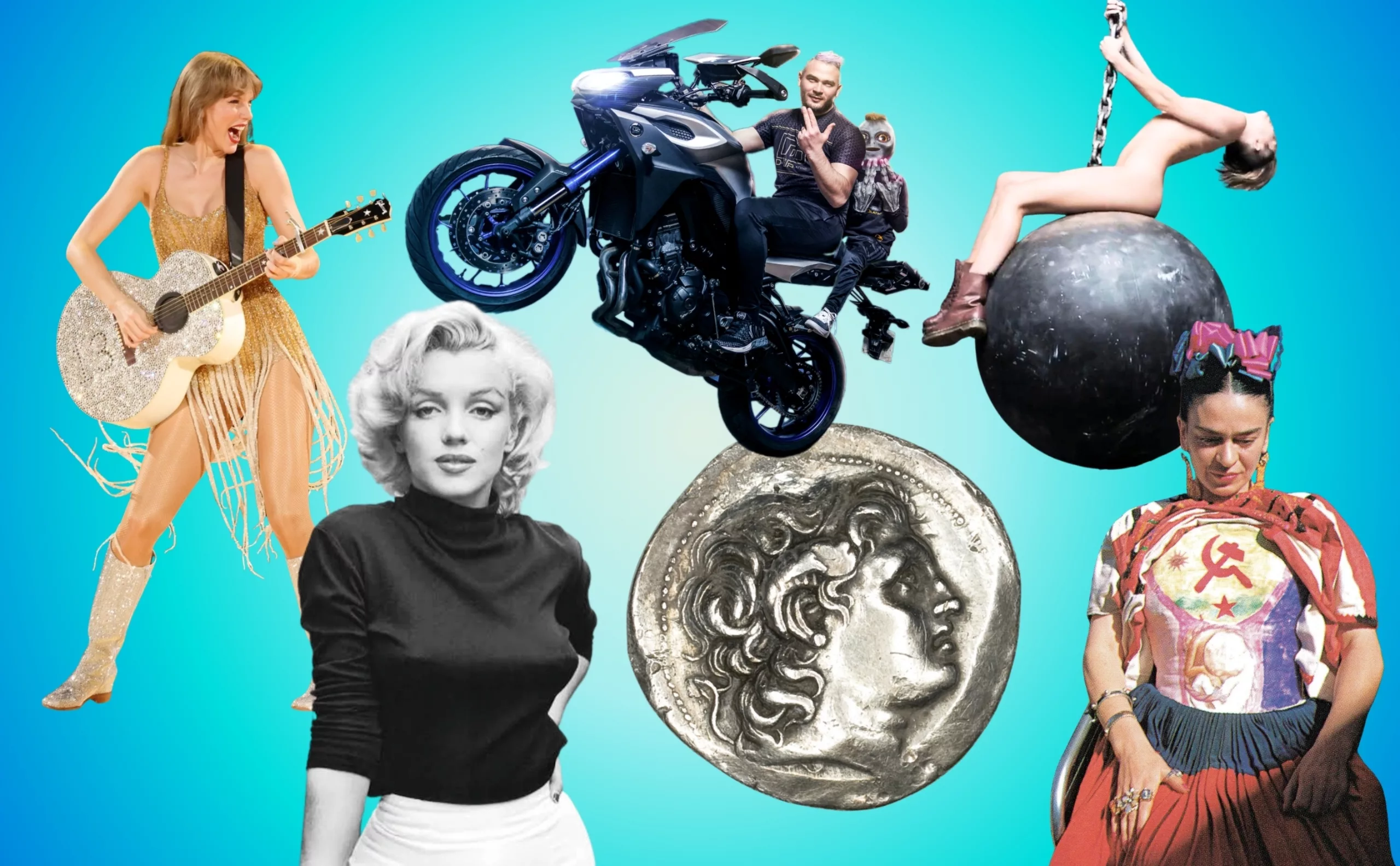
Iconic Branding: Building a Star Identity
Celebrities are a marketing product that can be manufactured or natural. Let’s take a closer look at celebrities’ personal branding and how they build their image or become icons, from Taylor Swift to Jul, via Marilyn. FIFA is removing logos, but making them more visible
-

FIFA is hiding logos, making them more visible
Being recognizable without a logo has become a goal. The question remains: How many brands will succeed in the future in being recognized solely by their silhouette without being confused with that of a competitor?
-
New logo for OM: analyzing a sports crest
OM will soon be changing its logo. This is an opportunity to delve into 125 years of heritage to understand the challenges of the future.